Scientists achieve ‘impossible’ solar efficiency in…
0 reactions
Scientists achieve ‘impossible’ solar efficiency in renewables breakthrough
>Researchers in Japan https://www.independent.co.uk/topic/japan ave developed a new material that allows solar cells to generate an amount of energy from sunlight that was previously thought impossible.
>The discovery, made by a team at Kyushu University, involves a special “spin-flip” emitter that can harvest energy from the Sun that is typically lost as heat.
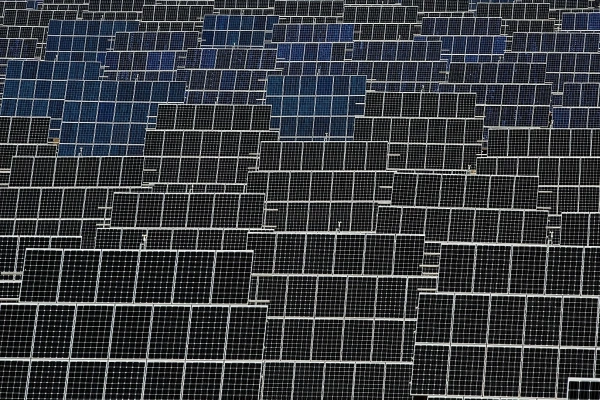
>The breakthrough overcomes the long-standing limit of conventional solar cells to achieve an energy conversion efficiency of 130 per cent – opening up new possibilities for ultra-efficient solar panels https://www.independent.co.uk/topic/solar-panels .
>With conventional solar cells, a single particle of light called a photon can generate one energy carrier, known as an exciton.
>Until now, solar cell technology has only been able to harvest energy from about one-third of the available sunlight due to higher-energy photons, like blue light, being lost as heat.
>The researchers used a process called singlet fission to split the excitons from the higher-energy photons into two lower-energy excitons – theoretically doubling the energy.
>“We have two main strategies to break through this limit,” said Yoichi Sasaki, Associate Professor at Kyushu University’s Faculty of Engineering.
>“One is to convert lower-energy infrared photons into higher energy visible photons. The other is to use singlet fission to generate two excitons from a single exciton photon.”
>The research was published in the *Journal of the American Chemical Society*, in a study https://pubs.acs.org/doi/10.1021/jacs.5c20500 itled ‘Exploring spin-state selective harvesting pathways from singlet fission dimers to a near-infrared-enissive spin-flip emitter’.
>The discovery is the latest in a string of recent breakthroughs with solar technology, making the renewable energy https://www.independent.co.uk/topic/renewable-energy ector increasingly efficient and cost effective.
>Earlier this month, a team in Switzerland set a new efficiency record for a new type of solar cell using the ‘miracle material https://tech.yahoo.com/science/articles/miracle-solar-tech-passes-key-150306308.html’ perovskite.
>By combining it with silicon, the researchers were able to achieve efficiency levels that rival satellite-grade solar panels at a fraction of the cost.
#inspiration sth
>Researchers in Japan https://www.independent.co.uk/topic/japan ave developed a new material that allows solar cells to generate an amount of energy from sunlight that was previously thought impossible.
>The discovery, made by a team at Kyushu University, involves a special “spin-flip” emitter that can harvest energy from the Sun that is typically lost as heat.
>The breakthrough overcomes the long-standing limit of conventional solar cells to achieve an energy conversion efficiency of 130 per cent – opening up new possibilities for ultra-efficient solar panels https://www.independent.co.uk/topic/solar-panels .
>With conventional solar cells, a single particle of light called a photon can generate one energy carrier, known as an exciton.
>Until now, solar cell technology has only been able to harvest energy from about one-third of the available sunlight due to higher-energy photons, like blue light, being lost as heat.
>The researchers used a process called singlet fission to split the excitons from the higher-energy photons into two lower-energy excitons – theoretically doubling the energy.
>“We have two main strategies to break through this limit,” said Yoichi Sasaki, Associate Professor at Kyushu University’s Faculty of Engineering.
>“One is to convert lower-energy infrared photons into higher energy visible photons. The other is to use singlet fission to generate two excitons from a single exciton photon.”
>The research was published in the *Journal of the American Chemical Society*, in a study https://pubs.acs.org/doi/10.1021/jacs.5c20500 itled ‘Exploring spin-state selective harvesting pathways from singlet fission dimers to a near-infrared-enissive spin-flip emitter’.
>The discovery is the latest in a string of recent breakthroughs with solar technology, making the renewable energy https://www.independent.co.uk/topic/renewable-energy ector increasingly efficient and cost effective.
>Earlier this month, a team in Switzerland set a new efficiency record for a new type of solar cell using the ‘miracle material https://tech.yahoo.com/science/articles/miracle-solar-tech-passes-key-150306308.html’ perovskite.
>By combining it with silicon, the researchers were able to achieve efficiency levels that rival satellite-grade solar panels at a fraction of the cost.
#inspiration sth


| 2,000 mlx | |
| 2 | |
| 0 |