
13 reactions
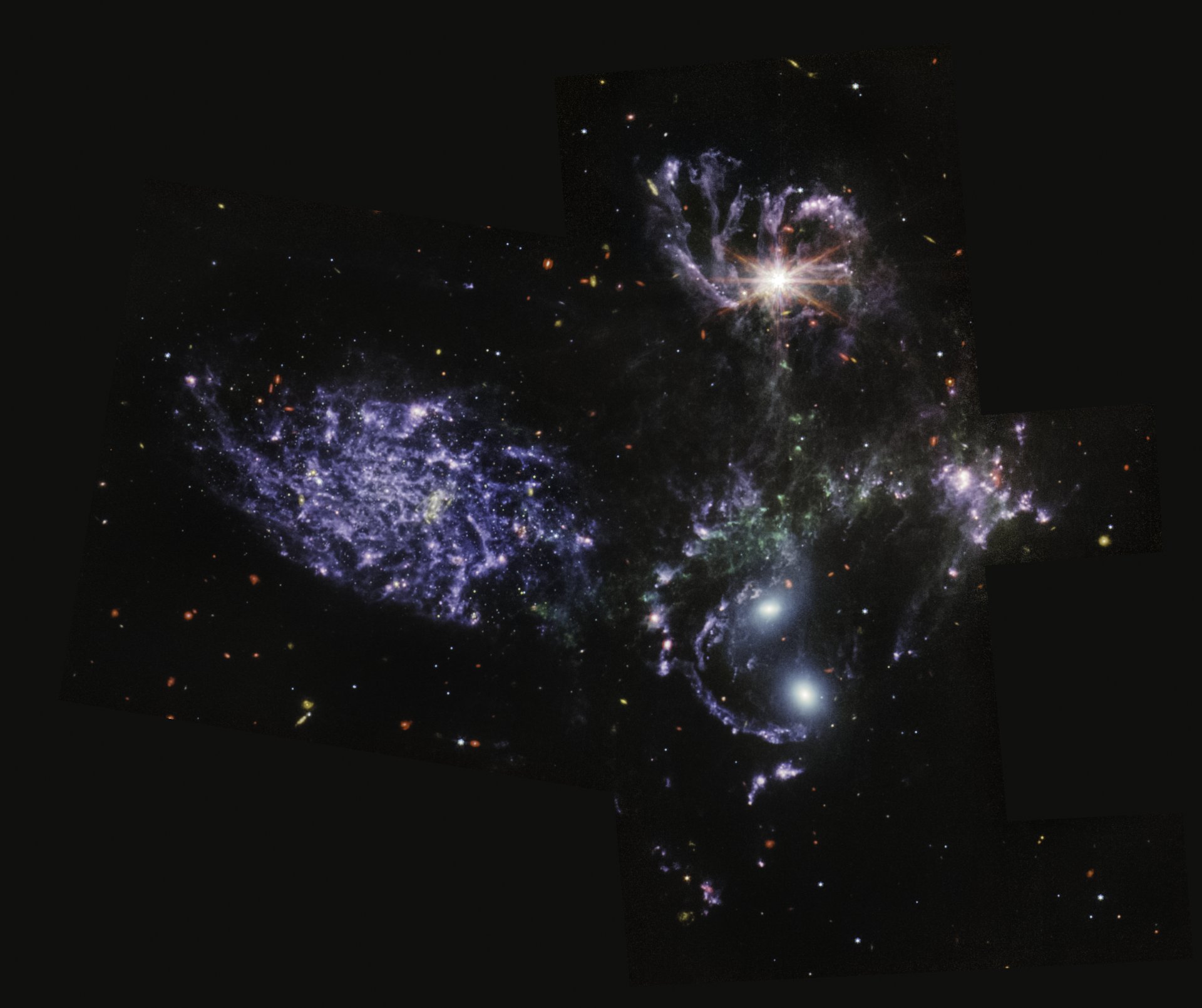
This image contains one more MIRI filter than was used in the NIRCam-MIRI composite picture. The image processing specialists at the Space Telescope Science Institute in Baltimore opted to use all three MIRI filters and the colors red, green and blue to most clearly differentiate the galaxy features from each other and the shock waves between the galaxies. In this image, red denotes dusty, star-forming regions, as well as extremely distant, early galaxies and galaxies enshrouded in thick dust. Blue point sources show stars or star clusters without dust. Diffuse areas of blue indicate dust that has a significant amount of large hydrocarbon molecules. For small background galaxies scattered throughout the image, the green and yellow colors represent more distant, earlier galaxies that are rich in these hydro carbons as well.
Credits: NASA, ESA, CSA, and STScI
#space #jameswebb #telescope #nasa #esa #csa #spacephoto #hubble #galactic
Image description
Stephan’s Quintet, a collection of five galaxies, as seen by MIRI on the James Webb Space Telescope. The galaxies all glow in different colors, surrounded by lacy, glowing clouds of gas and dust. Four of the five are centered in the image. Three are visibly spiral galaxies, with tendrils extending out from their glowing centers. The galaxy farthest to the left appears slightly more clearly, with vibrant blue lacing surrounding the oval-shaped light of the galaxy. This is because the farthest left galaxy is not interacting with the other four; it’s actually far in the foreground from the others. The galaxies all appear against a field of sparkling stars and other, farther galaxies.


9
| 51,000 mlx | |
| 111 | |
| 13 |