Untangling the signal A fibre-optic cable carries a city's…
0 reactions
Untangling the signal
A fibre-optic cable carries a city's conversations as pulses of light along a strand thinner than a hair. Tie one knot in it and the light leaks out.
Omics data has the same weakness. The genome, the transcriptome and the proteome each carry part of a biological signal. Read separately, each is a single strand. Left unreconciled, with mismatched identifiers, batch effects and files that cannot be joined, they become a tangle nobody can read as one story.
The fix in both worlds is the splice.
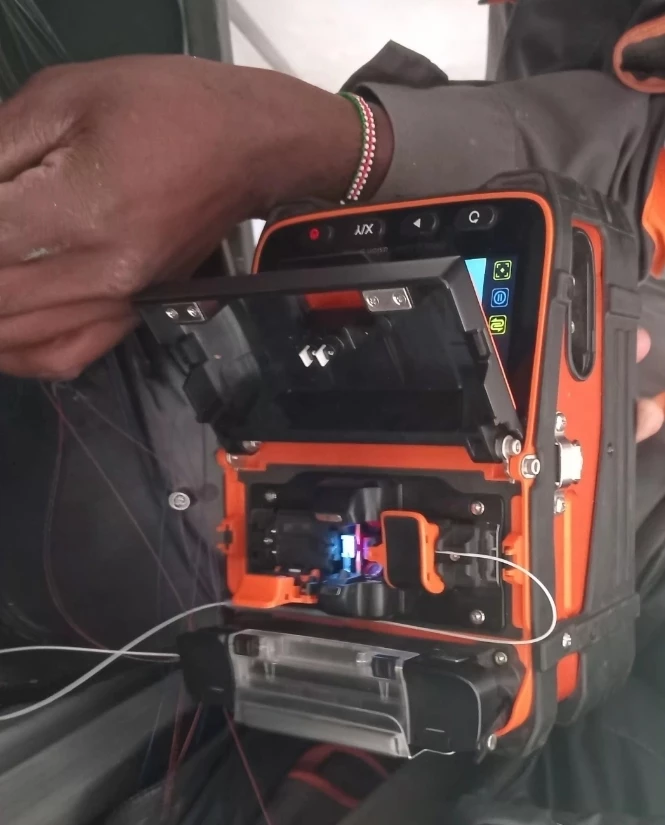
A fusion splicer holds two fibres in grooves, aligns their cores to a fraction of a hair's width, and fires a short arc that fuses them so light passes as if they were one. But nothing works on a dirty or badly cut fibre. The care happens before the arc, and the same is true of data.
1. Clean and cleave: strip and cut the fibre. In data, that is quality control and removing artefacts.
2. Align the cores: line up the glass. In data, match gene, protein and sample identifiers across layers.
3. Fuse: the arc joins the ends. In data, merge the layers into one integrated dataset.
4. Protect and test: sleeve the joint and measure the loss. In data, document the pipeline and check it against a known control.
Most of the work in multi-omics is preparation, and the networks around it matter too: shared standards, shared identifiers, and people who can read across layers.
When the splice is clean, the signal arrives intact.
#Genomics #Bioinformatics #MultiOmics #FibreOptics #Kenya


| 0 mlx | |
| 1 | |
| 0 |