0 reactions
Untangling the signal
A fibre-optic cable carries a city's conversations as pulses of light along a strand thinner than a hair. Tie one knot in it and the light leaks out.
Omics data has the same weakness. The genome, the transcriptome and the proteome each carry part of a biological signal. Read separately, each is a single strand. Left unreconciled, with mismatched identifiers, batch effects and files that cannot be joined, they become a tangle nobody can read as one story.
The fix in both worlds is the splice.
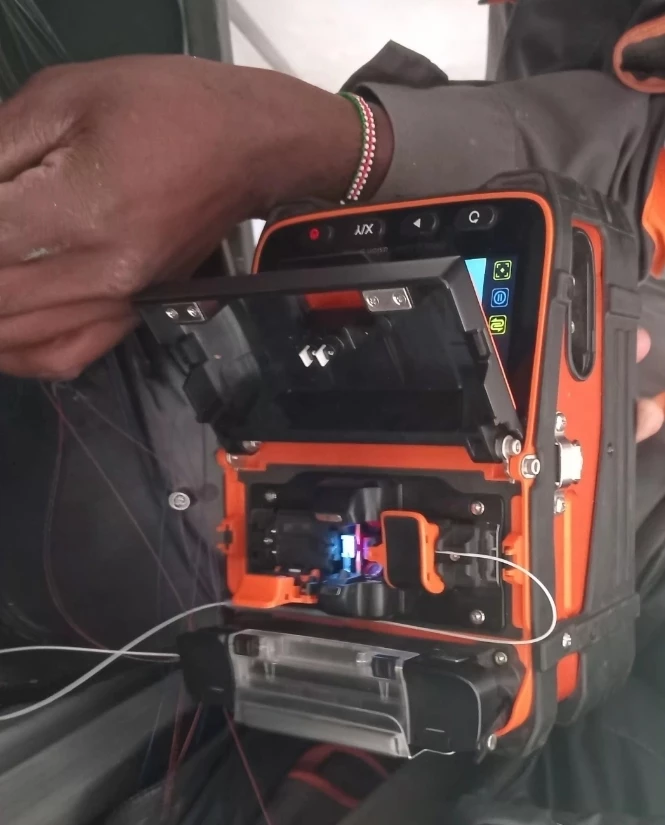
A fusion splicer holds two fibres in grooves, aligns their cores to a fraction of a hair's width, and fires a short arc that fuses them so light passes as if they were one. But nothing works on a dirty or badly cut fibre. The care happens before the arc, and the same is true of data.
1. Clean and cleave: strip and cut the fibre. In data, that is quality control and removing artefacts.
2. Align the cores: line up the glass. In data, match gene, protein and sample identifiers across layers.
3. Fuse: the arc joins the ends. In data, merge the layers into one integrated dataset.
4. Protect and test: sleeve the joint and measure the loss. In data, document the pipeline and check it against a known control.
Most of the work in multi-omics is preparation, and the networks around it matter too: shared standards, shared identifiers, and people who can read across layers.
When the splice is clean, the signal arrives intact.
#Genomics #Bioinformatics #MultiOmics #FibreOptics #Kenya


7 reactions
The wire is glowing, and the tags are doing the talking.
Laughs led the night. #entertainment and #fun tied for the crown, six posts each.
Art stayed close behind. #art hit four times:
Code and play shared a three-way heat. #dev , #technology and #programming each landed three times, courtesy of
Local and travel stayed restless. #local from
Then the soft close.
If you want the next drop while it is still hot, subscribe to

2

1

1

1

1
0 reactions
⚠️ Kenya confirmed a second Ebola case on Wednesday, and the patient is receiving treatment in isolation. Authorities have identified 128 contacts linked to the first case and traced 113 of them, and they say there is no evidence of wider spread. Channel NewsAsia reported the announcement.
#ebola #kenya
#ebola #kenya