The Soap Bubble Nebula and Crescent Nebula Captured From…
1 reactions
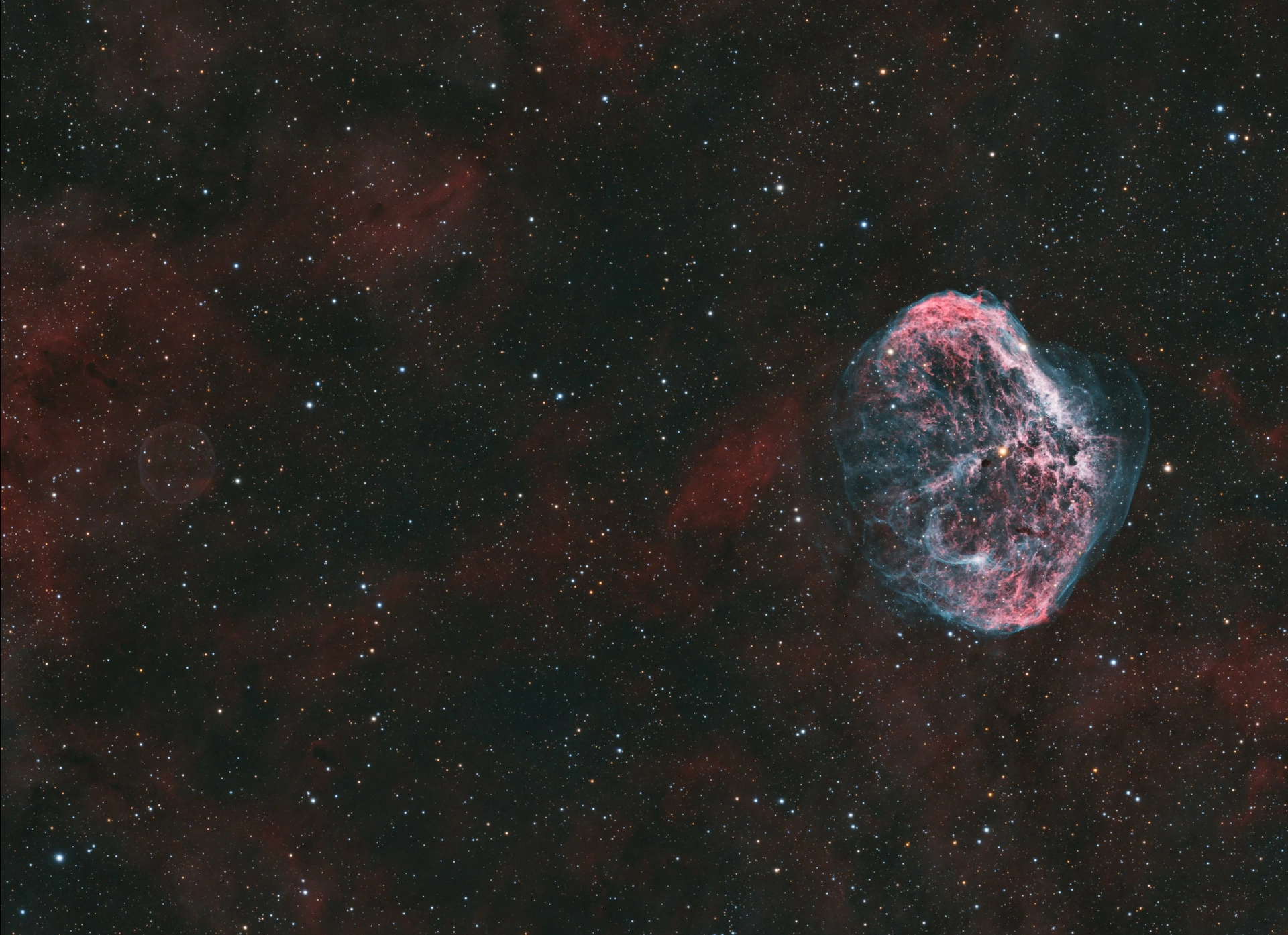
The Soap Bubble Nebula and Crescent Nebula Captured From My Backyard
I imaged the Soap Bubble Nebula (left) and the Crescent Nebula (right) over the past couple of weeks using Ha and OIII filters to create this HOO image.
The soap Bubble nebula has always been interesting to me since I first saw it and started learning about it. It particularly caught my interest as it's one of the few images discovered by an amateur astronomer. Dave Jurasevich discovered using a 160mm Astro-Physics Apo. He reported it only a 11-days before Robert Nemiroff (Co-Creator of Astrophysicist Photo of The Day - APOD) https://science.nasa.gov/image-article/apod-2015-december-4-cygnus-bubble-and-crescent/ and fellow astrophysicist Jerry Bonnell would report their independent discovery to the IAU.
The **Crescent Nebula** (also known as **NGC 6888**, **Caldwell 27**, **Sharpless 105**) is an emission nebula https://en.wikipedia.org/wiki/Emission_nebula in the constellation Cygnus https://en.wikipedia.org/wiki/Cygnus_(constellation ), about 5000 light-years https://en.wikipedia.org/wiki/Light-year away from Earth https://en.wikipedia.org/wiki/Earth . It was discovered by William Herschel https://en.wikipedia.org/wiki/William_Herschel in 1792.^(\[2\]) https://en.wikipedia.org/wiki/Crescent_Nebula#cite_note-ngcic-2 It is formed by the fast stellar wind https://en.wikipedia.org/wiki/Stellar_wind from the Wolf-Rayet star https://en.wikipedia.org/wiki/Wolf-Rayet_star WR 136 https://en.wikipedia.org/wiki/WR_136 (HD 192163) colliding with and energizing the slower moving wind ejected by the star when it became a red giant https://en.wikipedia.org/wiki/Red_giant around 250,000 years ago.^(\[3\]) https://en.wikipedia.org/wiki/Crescent_Nebula#cite_note-NASA-3 The result of the collision is a shell and two shock waves https://en.wikipedia.org/wiki/Shock_wave , one moving outward and one moving inward. The inward moving shock wave heats the stellar wind to X-ray https://en.wikipedia.org/wiki/X-ray\-emitting temperatures. - WIKIPEDIA
For anyone wondering why something that is closer to resembling an image of a space brain was named the Crescent Nebula: When looking at it under dark skies with filters or large aperture scopes, it looks like a crescent shape. Initial photographs also captured images without the full shell that resemble a crescent.
Total integration: 8h 55m
Integration per filter:
\- Hα: 3h 35m (43 × 300s)
\- OIII: 5h 20m (32 × 600s)
Full Resolution Links Below:
Astrobin Extra Large https://cdn.astrobin.com/thumbs/V8xbQqVMift__2560x0_n1wMX-gx.jpg?v=1793558500
Astrobin Minimally Processed Image https://cdn.astrobin.com/thumbs/um3wTdnO_PCd_2560x0_n1wMX-gx.jpg?v=1793559221
#space
source


1
| 2,000 mlx | |
| 1 | |
| 1 |