#GlitchInReality #EarnActivity By: @alidino Sponsored by…

1 reactions
#GlitchInReality
#EarnActivity
By:
Sponsored by:
Q: 1. Was it really an earthquake or some other phenomenon?
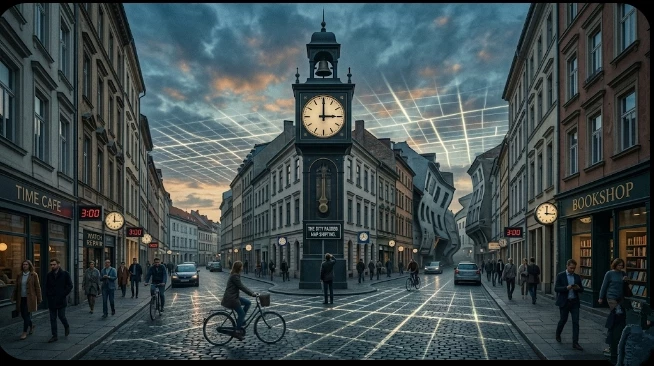
Ans: It was likely not a traditional earthquake, as those involve physical vibrations. Instead, it suggests a spatial-temporal anomaly—a disruption in the fabric of space and time. Because the clocks stopped while people felt no movement, it points to a localized "time freeze" or a glitch in the city's reality.
Q: 2. What does the stopping of clocks indicate?
Ans: The stopping of clocks indicates a temporary pause in the flow of time. If mechanical or digital clocks stop simultaneously across an entire city, it suggests that the local laws of physics (specifically the passage of time) were momentarily suspended or synchronized to a different timeline.
Q: 3. How did the city map change — was it reality or perception?
Ans: The map changed in reality. Since scientists could not explain it, it implies that the city literally "re-configured" its geography during the time pause. This suggests that the city exists in a state of flux where the landscape can be altered by outside forces, making the change a physical event rather than a collective hallucination.
Q: 4. If you were there, would you be able to notice it?
Ans: Probably not. If time itself paused, your consciousness and biological processes would also have paused along with the rest of the city. You would simply experience a "jump" in time where one moment it is 12:00 PM, and the next it is 12:01 PM, with no memory of the missing seconds—unless you were outside the affected area looking in.
#EarnActivity
By:
Sponsored by:
Q: 1. Was it really an earthquake or some other phenomenon?
Ans: It was likely not a traditional earthquake, as those involve physical vibrations. Instead, it suggests a spatial-temporal anomaly—a disruption in the fabric of space and time. Because the clocks stopped while people felt no movement, it points to a localized "time freeze" or a glitch in the city's reality.
Q: 2. What does the stopping of clocks indicate?
Ans: The stopping of clocks indicates a temporary pause in the flow of time. If mechanical or digital clocks stop simultaneously across an entire city, it suggests that the local laws of physics (specifically the passage of time) were momentarily suspended or synchronized to a different timeline.
Q: 3. How did the city map change — was it reality or perception?
Ans: The map changed in reality. Since scientists could not explain it, it implies that the city literally "re-configured" its geography during the time pause. This suggests that the city exists in a state of flux where the landscape can be altered by outside forces, making the change a physical event rather than a collective hallucination.
Q: 4. If you were there, would you be able to notice it?
Ans: Probably not. If time itself paused, your consciousness and biological processes would also have paused along with the rest of the city. You would simply experience a "jump" in time where one moment it is 12:00 PM, and the next it is 12:01 PM, with no memory of the missing seconds—unless you were outside the affected area looking in.


1
| 5,000 mlx | |
| 13 | |
| 1 |