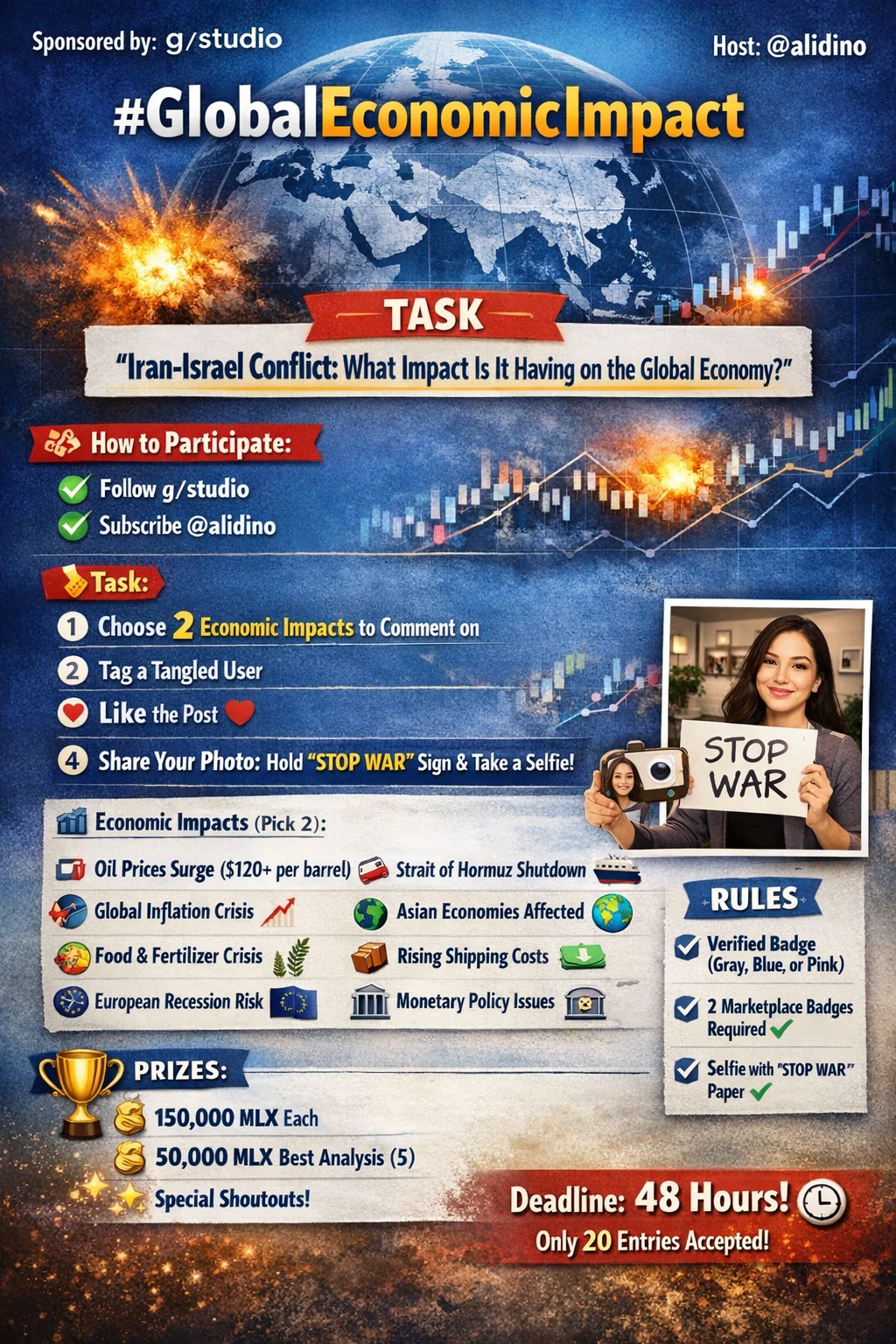
#GlobalEconomicImpact Sponsored by: g/studio Host…

20 reactions
#GlobalEconomicImpact
Sponsored by:
Host:
📝 How to Participate:
✔ Follow
✔ Subscribe
🎯 Task:
"Iran-Israel Conflict: What Impact Is It Having on the Global Economy?"
This conflict has not only harmed the Middle East region but also sent severe shocks throughout the world economy. Do you know what major losses the world is experiencing because of this war?
💬 Participation Steps:
1️⃣ Choose two economic impacts from the list below and share your analysis in the comments.
2️⃣ Tag a Tangled user.
3️⃣ ❤️ Like the post.
4️⃣ Share a photo with your analysis:
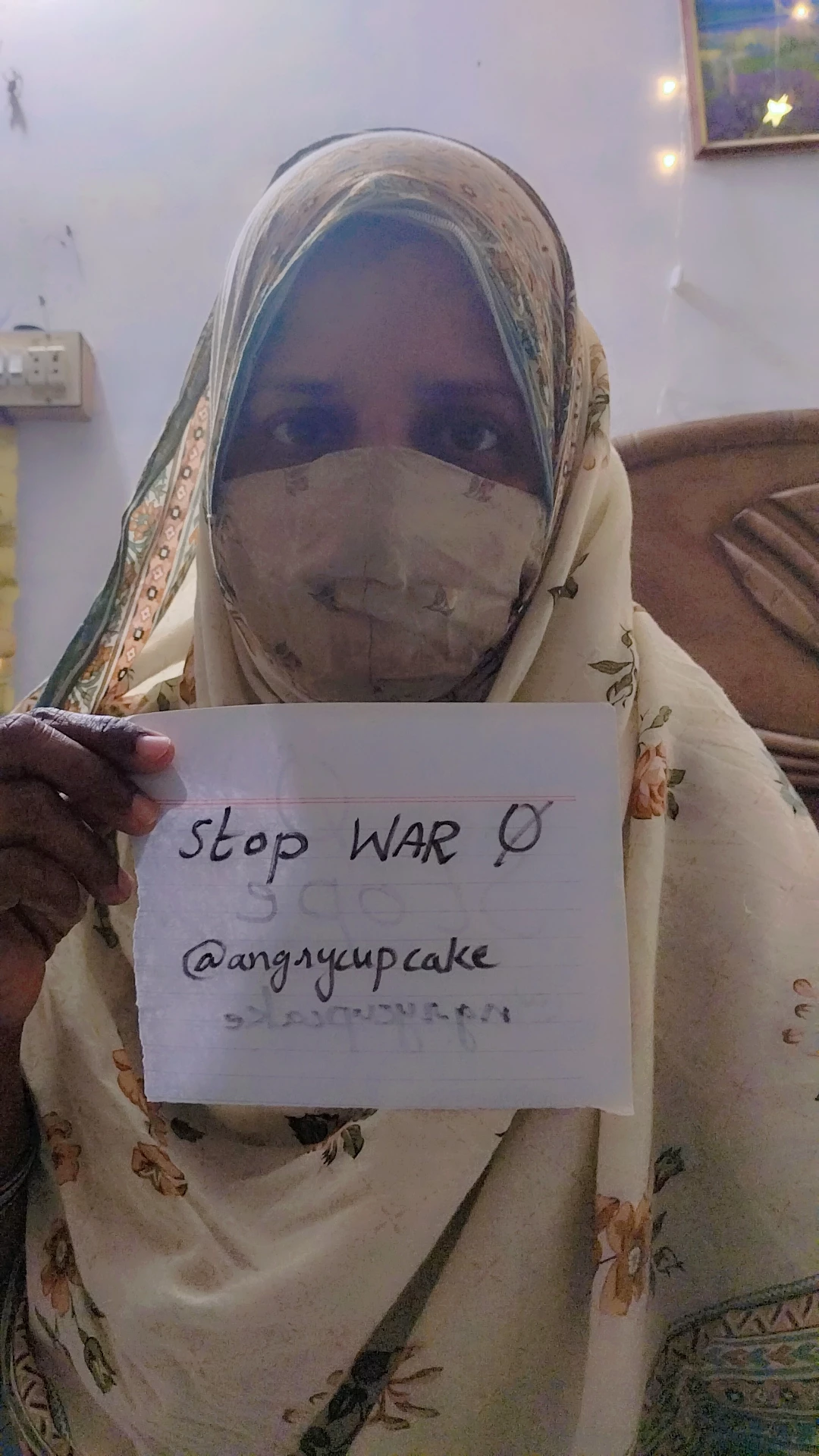
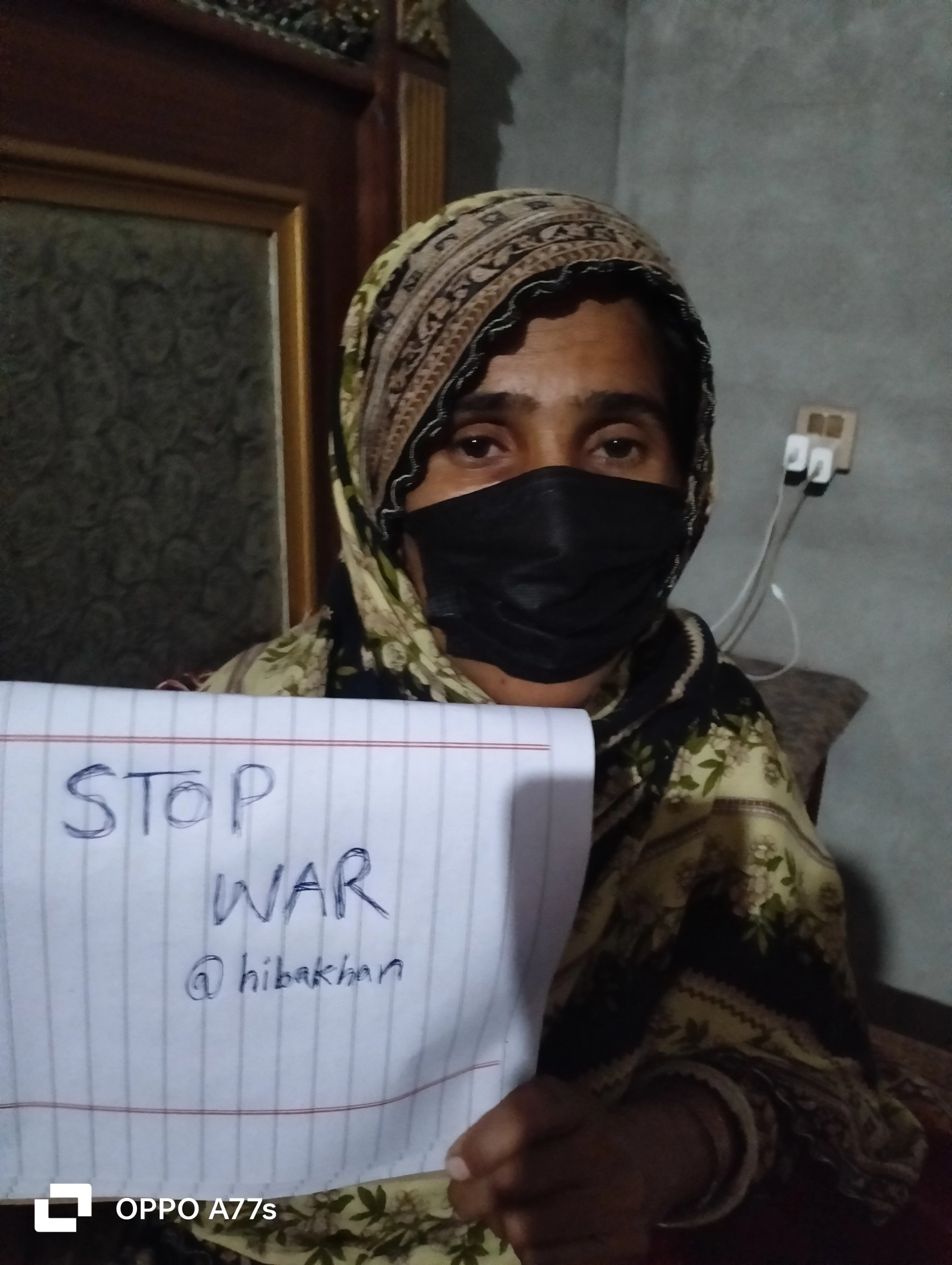
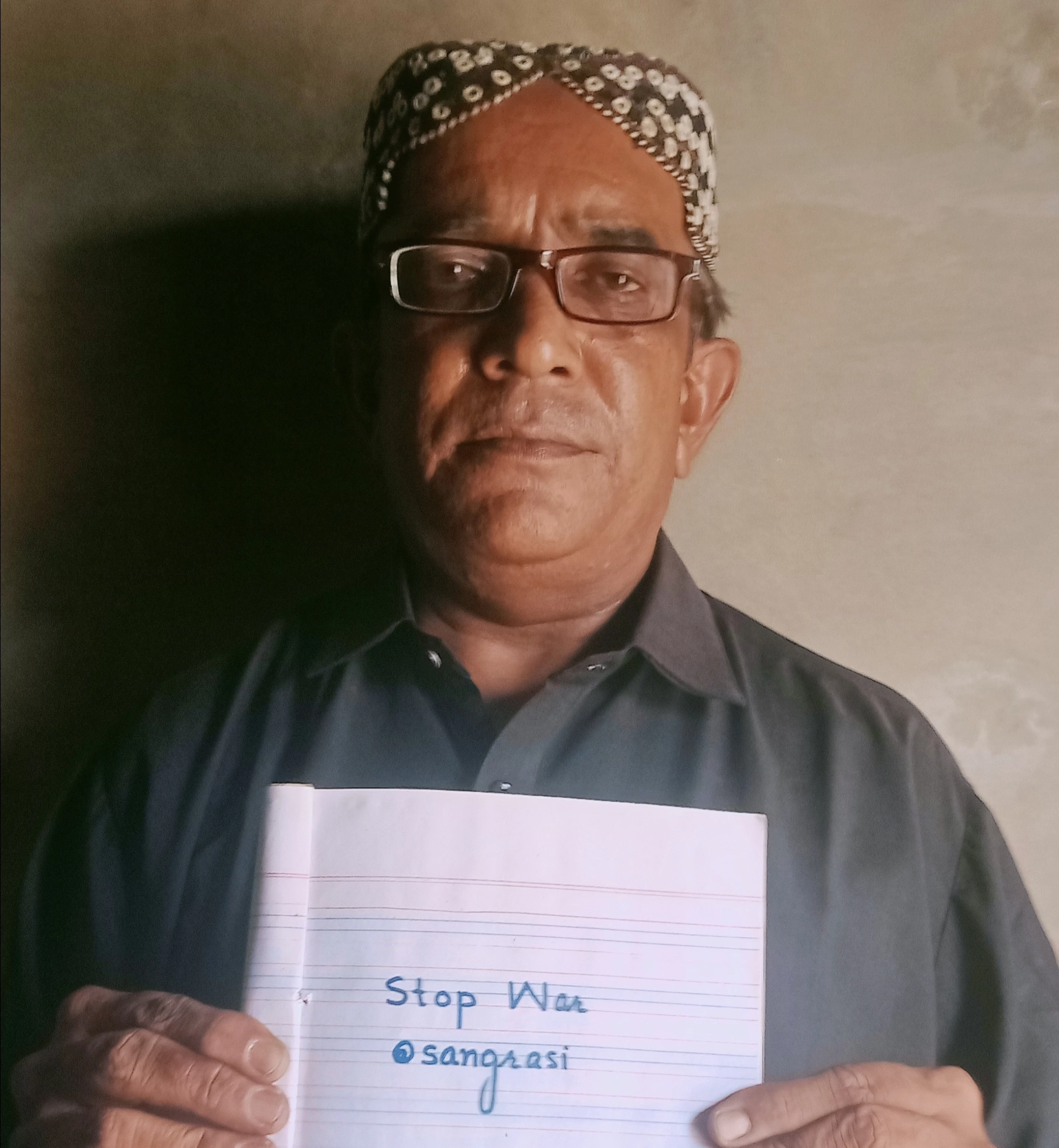
Write “STOP WAR” clearly on a paper
Take a selfie holding the paper
Upload the selfie along with your answer
🎨 Pick from these Economic Impacts (Choose two to explain):
Surge in oil prices (approx. $120+ per barrel) ⛽
Supply chain disruption due to closure of the Strait of Hormuz 🚢
Global inflation crisis 📈
Impact on Asian economies (China, India, Japan, Korea) 🌏
Fertilizer and food security crisis 🌾
Increase in shipping and insurance costs 💸
Global trade and manufacturing disruption 🏭
Risk of recession in European economies 🇪🇺
Complications in central banks’ monetary policies 🏦
Balance of payments pressure on developing countries ⚖️
📌 Rules / Eligibility:
✔ Participants must have a Verified Badge (Gray, Blue, or Pink) – visible on your profile.
✔ Must have at least 2 Marketplace Badges – to confirm eligibility.
✔ Only two answers per user are allowed.
✔ Include facts/figures in your answers (from reliable sources).
✔ Selfie with “STOP WAR” paper is mandatory.
🏆 Prizes:
💰 Each participant → 150,000 MLX
💰 Best detailed analysis → 50,000 MLX (5 participants)
✨ Special shoutout for all participants
⏳ Deadline & Limit:
✔ Only 20 entries will be accepted
✔ Deadline: 48 hours from posting (please include exact date & time for clarity)
Sponsored by:
Host:
📝 How to Participate:
✔ Follow
✔ Subscribe
🎯 Task:
"Iran-Israel Conflict: What Impact Is It Having on the Global Economy?"
This conflict has not only harmed the Middle East region but also sent severe shocks throughout the world economy. Do you know what major losses the world is experiencing because of this war?
💬 Participation Steps:
1️⃣ Choose two economic impacts from the list below and share your analysis in the comments.
2️⃣ Tag a Tangled user.
3️⃣ ❤️ Like the post.
4️⃣ Share a photo with your analysis:
Write “STOP WAR” clearly on a paper
Take a selfie holding the paper
Upload the selfie along with your answer
🎨 Pick from these Economic Impacts (Choose two to explain):
Surge in oil prices (approx. $120+ per barrel) ⛽
Supply chain disruption due to closure of the Strait of Hormuz 🚢
Global inflation crisis 📈
Impact on Asian economies (China, India, Japan, Korea) 🌏
Fertilizer and food security crisis 🌾
Increase in shipping and insurance costs 💸
Global trade and manufacturing disruption 🏭
Risk of recession in European economies 🇪🇺
Complications in central banks’ monetary policies 🏦
Balance of payments pressure on developing countries ⚖️
📌 Rules / Eligibility:
✔ Participants must have a Verified Badge (Gray, Blue, or Pink) – visible on your profile.
✔ Must have at least 2 Marketplace Badges – to confirm eligibility.
✔ Only two answers per user are allowed.
✔ Include facts/figures in your answers (from reliable sources).
✔ Selfie with “STOP WAR” paper is mandatory.
🏆 Prizes:
💰 Each participant → 150,000 MLX
💰 Best detailed analysis → 50,000 MLX (5 participants)
✨ Special shoutout for all participants
⏳ Deadline & Limit:
✔ Only 20 entries will be accepted
✔ Deadline: 48 hours from posting (please include exact date & time for clarity)


15

2

2
| 8,519,000 mlx | |
| 43 | |
| 20 |
comments
✅ Completed
This activity has been successfully completed and no further entries will be accepted.
All entries have been reviewed and the 3.5 M budget has been fully distributed.
Thank you everyone for your participation 💙
This activity has been successfully completed and no further entries will be accepted.
All entries have been reviewed and the 3.5 M budget has been fully distributed.
Thank you everyone for your participation 💙


#GlobalEconomicImpact
🌍 My Analysis on Iran-Israel Conflict Impact
1️⃣ Surge in Oil Prices ⛽
Due to rising tensions between Iran and Israel, oil prices have increased sharply, reaching around $120 per barrel. This is because Iran is close to the Strait of Hormuz, a key route where about 20% of the world’s oil supply passes daily.
When there is fear of conflict in this area, global oil supply becomes uncertain, causing prices to rise. This directly increases fuel prices, transport costs, and electricity bills worldwide.
2️⃣ Global Inflation Crisis 📈
Higher oil prices lead to increased costs for transportation and production. As a result, prices of goods like food, clothing, and daily essentials rise globally.
Many countries are already facing inflation above 5–8%, and this conflict is making it worse. Poor and developing countries are the most affected because people have less purchasing power.
Thanks 🙏


1:The Iran-Israel entire global economy. Rising oil prices and disrupted trade routes are affecting everyday life worldwide. It reminds us how deeply connected our economies are, where one conflict can impact millions far beyond its borders.
2:This conflict has triggered serious economic consequences, especially in energy markets and international trade. Fuel prices are rising, supply chains are under pressure, and uncertainty is slowing global growth. The effects are being felt in every corner of the world.
3:Wars don’t just destroy nations—they disrupt economies globally. The Iran-Israel conflict is causing inflation, higher oil prices, and instability in markets. It shows how peace is essential not only for safety but also for economic stability.
4:From increased oil prices to declining investor confidence, the Iran-Israel conflict is creating global economic stress. Businesses, governments, and individuals are all facing the ripple effects of this ongoing crisis.
5:The world economy is under pressure as the Iran-Israel conflict continues. Trade disruptions and energy crises are making life more expensive everywhere. It’s a powerful reminder of how conflict impacts not just countries, but the entire world.

#GlobalEconomicImpact
From what I’ve been following, the Iran-Israel conflict is no longer just a regional issue, it’s sending shockwaves across the global economy in ways that affect everyday life worldwide.
One major impact I’ve noticed is the surge in oil prices. . Oil prices have recently climbed to around $110–$120 per barrel , and analysts warn they could rise further if tensions continue. Since oil is at the heart of transportation and production, this increase pushes up fuel costs, electricity prices, and even the cost of basic goods. Institutions like the IMF have cautioned that prolonged high energy prices could fuel global inflation and slow economic growth , making life more expensive for both developed and developing countries. Source The Guardian.
Another serious concern is the disruption of the Strait of Hormuz, 🚢 a critical global shipping route through which about 20% of the world’s oil supply passes . Any instability or restriction in this area delays shipments and creates supply chain bottlenecks. This doesn’t just affect oil, it impacts global trade, manufacturing, and delivery of goods, especially in major economies across Asia and Europe that depend heavily on these routes. Source ING THINK
In my view, these impacts clearly show how interconnected our world is. A conflict in one region can quickly escalate into a global economic challenge, affecting prices, trade, and financial stability everywhere.
From what I’ve been following, the Iran-Israel conflict is no longer just a regional issue, it’s sending shockwaves across the global economy in ways that affect everyday life worldwide.
One major impact I’ve noticed is the surge in oil prices. . Oil prices have recently climbed to around $110–$120 per barrel , and analysts warn they could rise further if tensions continue. Since oil is at the heart of transportation and production, this increase pushes up fuel costs, electricity prices, and even the cost of basic goods. Institutions like the IMF have cautioned that prolonged high energy prices could fuel global inflation and slow economic growth , making life more expensive for both developed and developing countries. Source The Guardian.
Another serious concern is the disruption of the Strait of Hormuz, 🚢 a critical global shipping route through which about 20% of the world’s oil supply passes . Any instability or restriction in this area delays shipments and creates supply chain bottlenecks. This doesn’t just affect oil, it impacts global trade, manufacturing, and delivery of goods, especially in major economies across Asia and Europe that depend heavily on these routes. Source ING THINK
In my view, these impacts clearly show how interconnected our world is. A conflict in one region can quickly escalate into a global economic challenge, affecting prices, trade, and financial stability everywhere.


#GlobalEconomicImpact
Good afternoon Bhai
I just got home.
Thanks sissy
Here is my straight explanation of how Iran-Israel conflicts impact the world tackling #Energy Market Volatility, #Fuel -Driven Costs, #Global Inflation, #The "Hidden Tax, #Maritime Security Threats,#War-Risk Premiums, #The Long Reroute, #Extended Travel Time, #Increased Operational Costs, #Passing the Bill, #Consumer Price Hikes, #Manufacturing Disruption, #Production Slowdowns, #Scarcity Drives Prices...We may not be directly involved in the conflict but it's riffle effect indirectly hits us too.
Hahhaa meaning it isn't just a local issue but a worldwide plight🥴☹️
The tension between Iran and Israel might feel like a distant political issue, but it actually has a massive "ripple effect" that touches almost everyone’s pockets worldwide. This isn't just about headlines; it’s about Energy Security and the Global Supply Chain. When things get tense in the Middle East, the first thing we usually see is oil prices skyrocketing. Since that region is the heart of the world's fuel supply, any threat to the Strait of Hormuz—the most critical oil chokepoint on Earth—could send prices soaring over $120 per barrel. When fuel gets that expensive, it costs much more to run delivery trucks and power plants, leading to global inflation that makes groceries and basic needs pricier for everyone.
Beyond just gas prices, there is a "hidden tax" on almost everything we buy due to rising shipping and insurance costs. Because the Red Sea and the Suez Canal are also under threat, ships can no longer safely take the shortest path between Asia and Europe. Instead, insurance companies charge massive "war-risk" fees that can add millions of dollars to a single ship’s journey. To stay safe, many vessels are forced to reroute all the way around the Cape of Good Hope at the southern tip of Africa. This massive detour adds about 3,500 nautical miles and up to 14 extra days to the trip, which burns way more fuel and increases labor costs for the crew.
These shipping companies don't just eat those costs; they pass them directly to the businesses that sell us products. Since about 90% of the world's goods travel by sea, those extra thousands of dollars per container eventually show up as higher prices on store shelves. On top of that, these long delays cause a "parts shortage" for factories that can’t get their raw materials on time. When manufacturing slows down, products like electronics or cars become scarce, which drives prices even higher. Ultimately, a conflict at these specific "water gates" changes the cost of our daily lives, proving that we are all connected in this global economy.
References: Iran-Israel Conflict & Global Shipping
1. Oil Market Impact
Data: Oil prices projected to exceed $120/barrel if the Strait of Hormuz is blocked.
Source: PBS NewsHour / Rystad Energy Analysis (March 2026).
Context: Strait of Hormuz handles ~20% of global oil consumption (~20M barrels/day).
2. Shipping Rerouting (Cape of Good Hope)
Data: Detour adds ~3,500 nautical miles and 10–14 days to journeys between Asia and Europe.
Source: JPMorgan Research / International Transport Forum.
Cost: Additional fuel and labor costs estimated at $2M–$4M per voyage (DocShipper).
3. Insurance & War-Risk Premiums
Data: War-risk premiums spiked from 0.03% to 1% of vessel value.
Source: Bloomberg / Logistics Middle East.
Impact: Adds ~$1M in costs for a $100M vessel per transit.
4. Manufacturing & Inflation
Data: Shipping disruptions contribute ~0.7 percentage points to global core goods inflation.
Source: J.P. Morgan Research / BBC Business.
Examples: Production halts at Tesla and Volvo due to "Just-in-Time" parts shortages.
Good afternoon Bhai
I just got home.
Thanks sissy
Here is my straight explanation of how Iran-Israel conflicts impact the world tackling #Energy Market Volatility, #Fuel -Driven Costs, #Global Inflation, #The "Hidden Tax, #Maritime Security Threats,#War-Risk Premiums, #The Long Reroute, #Extended Travel Time, #Increased Operational Costs, #Passing the Bill, #Consumer Price Hikes, #Manufacturing Disruption, #Production Slowdowns, #Scarcity Drives Prices...We may not be directly involved in the conflict but it's riffle effect indirectly hits us too.
Hahhaa meaning it isn't just a local issue but a worldwide plight🥴☹️
The tension between Iran and Israel might feel like a distant political issue, but it actually has a massive "ripple effect" that touches almost everyone’s pockets worldwide. This isn't just about headlines; it’s about Energy Security and the Global Supply Chain. When things get tense in the Middle East, the first thing we usually see is oil prices skyrocketing. Since that region is the heart of the world's fuel supply, any threat to the Strait of Hormuz—the most critical oil chokepoint on Earth—could send prices soaring over $120 per barrel. When fuel gets that expensive, it costs much more to run delivery trucks and power plants, leading to global inflation that makes groceries and basic needs pricier for everyone.
Beyond just gas prices, there is a "hidden tax" on almost everything we buy due to rising shipping and insurance costs. Because the Red Sea and the Suez Canal are also under threat, ships can no longer safely take the shortest path between Asia and Europe. Instead, insurance companies charge massive "war-risk" fees that can add millions of dollars to a single ship’s journey. To stay safe, many vessels are forced to reroute all the way around the Cape of Good Hope at the southern tip of Africa. This massive detour adds about 3,500 nautical miles and up to 14 extra days to the trip, which burns way more fuel and increases labor costs for the crew.
These shipping companies don't just eat those costs; they pass them directly to the businesses that sell us products. Since about 90% of the world's goods travel by sea, those extra thousands of dollars per container eventually show up as higher prices on store shelves. On top of that, these long delays cause a "parts shortage" for factories that can’t get their raw materials on time. When manufacturing slows down, products like electronics or cars become scarce, which drives prices even higher. Ultimately, a conflict at these specific "water gates" changes the cost of our daily lives, proving that we are all connected in this global economy.
References: Iran-Israel Conflict & Global Shipping
1. Oil Market Impact
Data: Oil prices projected to exceed $120/barrel if the Strait of Hormuz is blocked.
Source: PBS NewsHour / Rystad Energy Analysis (March 2026).
Context: Strait of Hormuz handles ~20% of global oil consumption (~20M barrels/day).
2. Shipping Rerouting (Cape of Good Hope)
Data: Detour adds ~3,500 nautical miles and 10–14 days to journeys between Asia and Europe.
Source: JPMorgan Research / International Transport Forum.
Cost: Additional fuel and labor costs estimated at $2M–$4M per voyage (DocShipper).
3. Insurance & War-Risk Premiums
Data: War-risk premiums spiked from 0.03% to 1% of vessel value.
Source: Bloomberg / Logistics Middle East.
Impact: Adds ~$1M in costs for a $100M vessel per transit.
4. Manufacturing & Inflation
Data: Shipping disruptions contribute ~0.7 percentage points to global core goods inflation.
Source: J.P. Morgan Research / BBC Business.
Examples: Production halts at Tesla and Volvo due to "Just-in-Time" parts shortages.


#GlobalEconomicImpact
For me, two big effects of the Iran-Israel conflict on the global economy are the rise in oil prices and global inflation.
First, oil prices go up a lot because the Middle East is one of the main sources of oil. When there is conflict, supply becomes risky, especially if routes like the Strait of Hormuz are affected. Because of that, oil prices can reach around $120 per barrel or even higher. When oil is expensive, everything else becomes expensive too, like transportation and electricity.
Second is global inflation. Since fuel prices increase, the cost of goods and services also goes up. Food, basic needs, and even shipping become more expensive. This affects many countries, especially developing ones, because people have to spend more but their income stays the same.
Overall, this kind of conflict doesn’t just affect one region, it affects the whole world, especially the economy and daily living of people
For me, two big effects of the Iran-Israel conflict on the global economy are the rise in oil prices and global inflation.
First, oil prices go up a lot because the Middle East is one of the main sources of oil. When there is conflict, supply becomes risky, especially if routes like the Strait of Hormuz are affected. Because of that, oil prices can reach around $120 per barrel or even higher. When oil is expensive, everything else becomes expensive too, like transportation and electricity.
Second is global inflation. Since fuel prices increase, the cost of goods and services also goes up. Food, basic needs, and even shipping become more expensive. This affects many countries, especially developing ones, because people have to spend more but their income stays the same.
Overall, this kind of conflict doesn’t just affect one region, it affects the whole world, especially the economy and daily living of people


1. Surge in Oil Prices ($120+): Conflict in the Middle East creates an immediate risk premium. If oil hits $120+, the cost of production and transport worldwide will skyrocket, hitting every consumer's pocket.
2. Strait of Hormuz Disruption: Closing this chokepoint would trap 20% of the world’s oil supply. This wouldn't just cause an energy crisis; it would paralyze global shipping and trade routes for months.
Peace is the only solution.stopwar
2. Strait of Hormuz Disruption: Closing this chokepoint would trap 20% of the world’s oil supply. This wouldn't just cause an energy crisis; it would paralyze global shipping and trade routes for months.
Peace is the only solution.stopwar


🛑 STOP WAR 🛑
Iran-Israel Conflict: Global Economic Impact
1️⃣ Surge in Oil Prices ⛽
Geopolitical tensions in the Middle East, especially around the Strait of Hormuz (through which ~20% of global oil passes), have driven oil prices above $120 per barrel. This raises production and transportation costs worldwide, affecting everyday goods and services.
2️⃣ Global Inflation Crisis 📈
Rising energy costs are fueling inflation globally. IMF estimates suggest a 0.5–1.5% increase in global inflation due to higher fuel and shipping costs, hitting consumers’ purchasing power in import-dependent nations.
💬 Let’s spread awareness and demand peace.
Tagging:
Iran-Israel Conflict: Global Economic Impact
1️⃣ Surge in Oil Prices ⛽
Geopolitical tensions in the Middle East, especially around the Strait of Hormuz (through which ~20% of global oil passes), have driven oil prices above $120 per barrel. This raises production and transportation costs worldwide, affecting everyday goods and services.
2️⃣ Global Inflation Crisis 📈
Rising energy costs are fueling inflation globally. IMF estimates suggest a 0.5–1.5% increase in global inflation due to higher fuel and shipping costs, hitting consumers’ purchasing power in import-dependent nations.
💬 Let’s spread awareness and demand peace.
Tagging:


Iran–Israel Conflict: Global Economic Impact
This conflict is not just affecting one region—it’s shaking the entire world economy.
1. Energy Crisis & Rising Oil Prices
Tensions in key oil routes like the Strait of Hormuz have disrupted supply, causing oil prices to surge. As fuel becomes expensive, transportation, electricity, and daily goods all become costlier. Simply put: when oil prices rise, everything else follows.
2. Global Inflation & Slower Growth
Higher energy costs are driving inflation worldwide. People are paying more for basic needs, while businesses struggle with rising expenses. At the same time, economic growth is slowing down, increasing the risk of recession in many countries.
This conflict is not just affecting one region—it’s shaking the entire world economy.
1. Energy Crisis & Rising Oil Prices
Tensions in key oil routes like the Strait of Hormuz have disrupted supply, causing oil prices to surge. As fuel becomes expensive, transportation, electricity, and daily goods all become costlier. Simply put: when oil prices rise, everything else follows.
2. Global Inflation & Slower Growth
Higher energy costs are driving inflation worldwide. People are paying more for basic needs, while businesses struggle with rising expenses. At the same time, economic growth is slowing down, increasing the risk of recession in many countries.

Global Trade and Manufacturing Disruption 🏭
The Iran-Israel conflict has severely disrupted global supply chains, especially for oil and gas, as tensions rise near the Persian Gulf and Strait of Hormuz. As a result:
Shipping costs have increased 💸
Raw material shortages are affecting global manufacturing
Major companies face delays in production and delivery
Example: According to the World Trade Organization (WTO), such conflicts could cause annual losses of $50–70 billion if supply chains remain affected.
2️⃣ Risk of Recession in European Economies 🇪🇺
Rising energy prices and supply chain issues are increasing the risk of recession in Europe. Specifically:
Industries in Germany, France, and Italy are impacted by inflation and energy shortages
Consumer spending is slowing, which reduces economic growth
The European Central Bank (ECB) faces pressure to implement stricter monetary policies
Data: According to the European Commission, a 30% rise in energy prices could negatively affect European GDP by 0.5–1%.
The Iran-Israel conflict has severely disrupted global supply chains, especially for oil and gas, as tensions rise near the Persian Gulf and Strait of Hormuz. As a result:
Shipping costs have increased 💸
Raw material shortages are affecting global manufacturing
Major companies face delays in production and delivery
Example: According to the World Trade Organization (WTO), such conflicts could cause annual losses of $50–70 billion if supply chains remain affected.
2️⃣ Risk of Recession in European Economies 🇪🇺
Rising energy prices and supply chain issues are increasing the risk of recession in Europe. Specifically:
Industries in Germany, France, and Italy are impacted by inflation and energy shortages
Consumer spending is slowing, which reduces economic growth
The European Central Bank (ECB) faces pressure to implement stricter monetary policies
Data: According to the European Commission, a 30% rise in energy prices could negatively affect European GDP by 0.5–1%.

1. Global Inflation Crisis:
Iran-Israel conflict ki wajah se Middle East mein supply shocks aa rahe hain. Oil prices ka sudden surge ($120+ per barrel) aur trade disruptions ne global inflation ko tez kar diya hai. Countries jahan already high inflation chal rahi thi (jaise USA, UK, aur Europe ke kuch economies) wahan prices of basic goods aur energy products aur barh gaye hain. IMF ke recent data ke mutabiq, global inflation 2026 ke start mein 6% ke aas paas record ki gayi hai, jo pehle se kaafi zyada hai. Yeh consumer purchasing power ko kam kar raha hai aur central banks ko interest rate hikes par majboor kar raha ha.
2. Fertilizer and Food Security Crisis:
Middle East ke conflict ki wajah se fertilizer exports aur imports disrupt ho rahe hain, kyunki Iran aur surrounding regions se urea aur phosphates ki supply affect ho rahi hai. India aur Pakistan jaise countries jahan agriculture heavily dependent hai imported fertilizers par, wahan khad ki kami ki wajah se crops ka production gir sakta hai. World Food Programme ka estimate kehta hai ke agar ye conflict lamba chala, to global food prices 10–15% aur barh sakte hain, jo developing countries mein hunger aur malnutrition ke risks ko amplify karega.
Iran-Israel conflict ki wajah se Middle East mein supply shocks aa rahe hain. Oil prices ka sudden surge ($120+ per barrel) aur trade disruptions ne global inflation ko tez kar diya hai. Countries jahan already high inflation chal rahi thi (jaise USA, UK, aur Europe ke kuch economies) wahan prices of basic goods aur energy products aur barh gaye hain. IMF ke recent data ke mutabiq, global inflation 2026 ke start mein 6% ke aas paas record ki gayi hai, jo pehle se kaafi zyada hai. Yeh consumer purchasing power ko kam kar raha hai aur central banks ko interest rate hikes par majboor kar raha ha.
2. Fertilizer and Food Security Crisis:
Middle East ke conflict ki wajah se fertilizer exports aur imports disrupt ho rahe hain, kyunki Iran aur surrounding regions se urea aur phosphates ki supply affect ho rahi hai. India aur Pakistan jaise countries jahan agriculture heavily dependent hai imported fertilizers par, wahan khad ki kami ki wajah se crops ka production gir sakta hai. World Food Programme ka estimate kehta hai ke agar ye conflict lamba chala, to global food prices 10–15% aur barh sakte hain, jo developing countries mein hunger aur malnutrition ke risks ko amplify karega.
⛽ Surge in Oil Prices (approx. $120+ per barrel)
When conflicts or tensions affect oil-producing regions, oil supply becomes uncertain. This pushes prices up quickly.
👉 Higher oil prices mean:
Fuel becomes expensive (petrol, diesel)
Transport costs rise → everything becomes more expensive
Electricity costs increase in many countries
💡 Result: Everyday living costs go up, and economies slow down because people spend less.
🚢 Supply Chain Disruption due to Closure of the Strait of Hormuz
The Strait of Hormuz is one of the world’s most important shipping routes for oil and goods. If it gets blocked or unsafe:
👉 Effects include:
Oil and goods cannot move smoothly
Delays in delivery of products worldwide
Shortages of important items in markets
💡 Result: Businesses struggle, prices rise, and global trade becomes unstable.
When conflicts or tensions affect oil-producing regions, oil supply becomes uncertain. This pushes prices up quickly.
👉 Higher oil prices mean:
Fuel becomes expensive (petrol, diesel)
Transport costs rise → everything becomes more expensive
Electricity costs increase in many countries
💡 Result: Everyday living costs go up, and economies slow down because people spend less.
🚢 Supply Chain Disruption due to Closure of the Strait of Hormuz
The Strait of Hormuz is one of the world’s most important shipping routes for oil and goods. If it gets blocked or unsafe:
👉 Effects include:
Oil and goods cannot move smoothly
Delays in delivery of products worldwide
Shortages of important items in markets
💡 Result: Businesses struggle, prices rise, and global trade becomes unstable.


Oil Price Surge & Global Inflation Crisis
The Iran-Israel conflict has significantly increased global oil prices, reaching around $120+ per barrel. Since oil is a key resource for transportation, energy, and industrial production, this rise directly increases the cost of almost everything.
Higher fuel prices lead to increased transportation costs, which in turn raise the prices of food, goods, and daily necessities. As a result, countries around the world are facing a serious inflation crisis.
Developing countries like Pakistan are especially affected because their economies are already fragile. Rising inflation reduces people’s purchasing power, increases poverty, and creates economic instability.
Overall, the surge in oil prices due to this conflict is one of the major reasons behind the current global inflation crisis.
The Iran-Israel conflict has significantly increased global oil prices, reaching around $120+ per barrel. Since oil is a key resource for transportation, energy, and industrial production, this rise directly increases the cost of almost everything.
Higher fuel prices lead to increased transportation costs, which in turn raise the prices of food, goods, and daily necessities. As a result, countries around the world are facing a serious inflation crisis.
Developing countries like Pakistan are especially affected because their economies are already fragile. Rising inflation reduces people’s purchasing power, increases poverty, and creates economic instability.
Overall, the surge in oil prices due to this conflict is one of the major reasons behind the current global inflation crisis.
1️⃣ "Rising oil prices and global inflation are pushing economies to the edge. It's time to say STOP WAR before the damage becomes irreversible."
2️⃣ "Supply chains are breaking, costs are rising, and the world is paying the price. Peace is not a choice anymore—it’s a necessity. STOP WAR."
2️⃣ "Supply chains are breaking, costs are rising, and the world is paying the price. Peace is not a choice anymore—it’s a necessity. STOP WAR."

Impact of Iran-Israel conflict on global economy”
1️⃣ Oil price hike ⛽
The war has affected the supply of oil in the global market, causing oil prices to rise to around $120+ per barrel. This is causing inflation and an increase in energy costs.
2️⃣ Global inflation crisis 📈
Rising oil and food prices are increasing inflation worldwide, making it difficult for ordinary people to afford more.
STOP WAR ✋🕊
1️⃣ Oil price hike ⛽
The war has affected the supply of oil in the global market, causing oil prices to rise to around $120+ per barrel. This is causing inflation and an increase in energy costs.
2️⃣ Global inflation crisis 📈
Rising oil and food prices are increasing inflation worldwide, making it difficult for ordinary people to afford more.
STOP WAR ✋🕊
Economic Impacts:
1️⃣ Supply chain disruption 🚢 – Conflicts can block key routes like the Strait of Hormuz, delaying goods and causing shortages around the world.
2️⃣ Food security crisis 🌾 – War affects fertilizer and farming, leading to lower crop production and rising food prices, especially in poorer countries.
1️⃣ Supply chain disruption 🚢 – Conflicts can block key routes like the Strait of Hormuz, delaying goods and causing shortages around the world.
2️⃣ Food security crisis 🌾 – War affects fertilizer and farming, leading to lower crop production and rising food prices, especially in poorer countries.

⛽ 1. Surge in Oil Prices (Above $120 per barrel)
Due to rising tensions in the Middle East (which produces about 30% of global oil supply), oil prices have surged past $120/barrel.
👉 Pakistan heavily depends on imported oil, so this leads to:
• Higher petrol and diesel prices
• Increased electricity costs
• Rising transportation and production expenses
👉 According to global estimates, every $10 increase in oil can raise inflation by 0.4%–0.6% in developing economies.
🚢 2. Supply Chain Disruption (Strait of Hormuz Risk)
Around 20% of the world’s oil supply passes through the Strait of Hormuz. Any blockage or threat in this route disrupts global trade.
👉 Delays in shipping increase costs and create shortages of essential goods
👉 Import-dependent countries like Pakistan face serious risks in fuel and raw material supply
👉 Global trade slows down, affecting industries worldwide
Due to rising tensions in the Middle East (which produces about 30% of global oil supply), oil prices have surged past $120/barrel.
👉 Pakistan heavily depends on imported oil, so this leads to:
• Higher petrol and diesel prices
• Increased electricity costs
• Rising transportation and production expenses
👉 According to global estimates, every $10 increase in oil can raise inflation by 0.4%–0.6% in developing economies.
🚢 2. Supply Chain Disruption (Strait of Hormuz Risk)
Around 20% of the world’s oil supply passes through the Strait of Hormuz. Any blockage or threat in this route disrupts global trade.
👉 Delays in shipping increase costs and create shortages of essential goods
👉 Import-dependent countries like Pakistan face serious risks in fuel and raw material supply
👉 Global trade slows down, affecting industries worldwide


Here is my pick,
Surge in oil prices (approx. $120+ per barrel.
Energy crises are most common effect from this war. Gasoline is back bone in any country's economy and in this war the prices of gasoline hits record especially in countries like Pakistan. 55 rupee overnight increase made life more terrible. Definitely it effects on cost of production, transportation and logistics.
Global inflation crisis 📈
Surely this war making graphics of inflation into different shades. As I stated above, those reasons are key in global inflation where commodities and transportation both rising rapidly. These crises going to shake the world overall especially the poor countries.
Surge in oil prices (approx. $120+ per barrel.
Energy crises are most common effect from this war. Gasoline is back bone in any country's economy and in this war the prices of gasoline hits record especially in countries like Pakistan. 55 rupee overnight increase made life more terrible. Definitely it effects on cost of production, transportation and logistics.
Global inflation crisis 📈
Surely this war making graphics of inflation into different shades. As I stated above, those reasons are key in global inflation where commodities and transportation both rising rapidly. These crises going to shake the world overall especially the poor countries.

I am sorry.. This is by mistake as I posted on timeline so I had to delete this one. I really apologies. Thanks