Voter turnout vs. Vote share of the winner in Sri Lankan…

0 reactions
Voter turnout vs. Vote share of the winner in Sri Lankan presidential elections
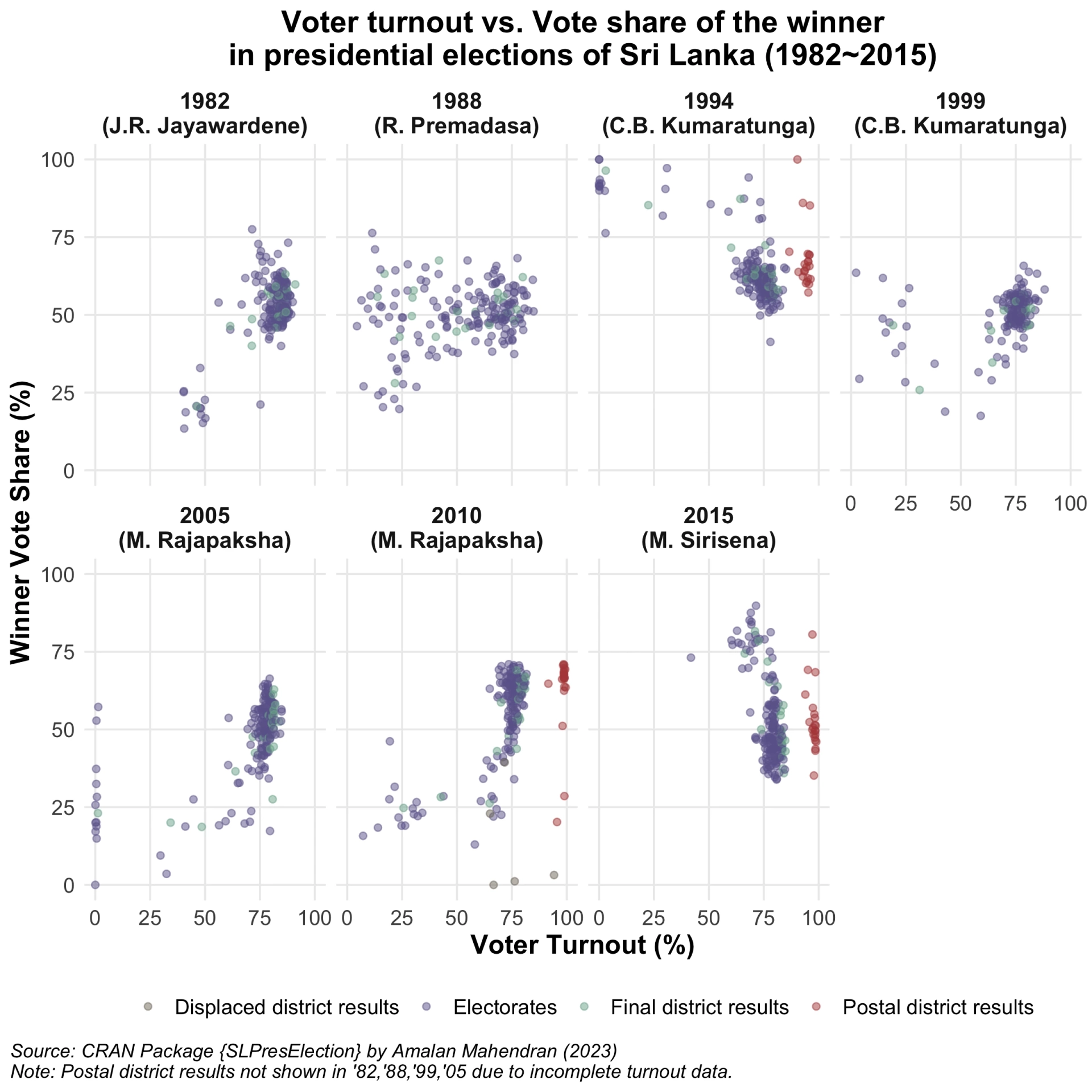
I read the following article which discusses how Voter turnout vs. Vote share of the winner can act as a fingerprint to detect election fraud (abnormally high turnout AND vote share will show up on the upper right corner. Examples included in the paper). I decided to try it out on Sri Lankan presidential election data.
>P. Klimek, Y. Yegorov, R. Hanel, & S. Thurner, Statistical detection of systematic election irregularities, Proc. Natl. Acad. Sci. U.S.A. 109 (41) 16469-16473, https://doi.org/10.1073/pnas.1210722109 (2012).
Data + CRAN Package: https://doi.org/10.32614/CRAN.package.SLPresElection
Tools: RStudio
The year on top of each plot is the year in which the presidential election was held. The name within parenthesis is the winning candidate. I classified different data types as they can have different circumstances.
Postal district votes: These results have very high turnout rates because the voters who cannot cast their vote on the day of the election due to being involved in the election duties, or in essential services including the military and police. In Sri Lankan elections, these results usually come out first and are seen as a strong predictor as to who will win the election.
Displaced district results: I believe these were special electorate cases as a result of the civil war that ended in 2009, leaving several thousand people displaced.
Final district results: This is the aggregate of all underlying electorates within a respective district.
#education
source
I read the following article which discusses how Voter turnout vs. Vote share of the winner can act as a fingerprint to detect election fraud (abnormally high turnout AND vote share will show up on the upper right corner. Examples included in the paper). I decided to try it out on Sri Lankan presidential election data.
>P. Klimek, Y. Yegorov, R. Hanel, & S. Thurner, Statistical detection of systematic election irregularities, Proc. Natl. Acad. Sci. U.S.A. 109 (41) 16469-16473, https://doi.org/10.1073/pnas.1210722109 (2012).
Data + CRAN Package: https://doi.org/10.32614/CRAN.package.SLPresElection
Tools: RStudio
The year on top of each plot is the year in which the presidential election was held. The name within parenthesis is the winning candidate. I classified different data types as they can have different circumstances.
Postal district votes: These results have very high turnout rates because the voters who cannot cast their vote on the day of the election due to being involved in the election duties, or in essential services including the military and police. In Sri Lankan elections, these results usually come out first and are seen as a strong predictor as to who will win the election.
Displaced district results: I believe these were special electorate cases as a result of the civil war that ended in 2009, leaving several thousand people displaced.
Final district results: This is the aggregate of all underlying electorates within a respective district.
#education
source


| 1,000 mlx | |
| 1 | |
| 0 |