
4 reactions
NASA's Webb Identifies Tiniest Free-Floating Brown Dwarf (NIRCam Image)
Unique. That’s what you are.
Not quite stars, not quite planets — brown dwarfs are objects that fall in between. Within the star cluster shown in this image, Webb observed the tiniest, free-floating brown dwarf ever discovered.
Webb’s sharp infrared eye found this record-breaking brown dwarf in star cluster IC 348, which is about 1000 light-years away and only 5 million years old.
Studying brown dwarfs helps us understand star formation as well as exoplanets, or planets beyond our solar system. Not only is there overlap between the smallest brown dwarfs and the largest exoplanets, free-floating brown dwarfs come with no stars attached — unlike exoplanets, which can be hidden in the glare of their host stars.
But brown dwarfs aren’t the only free agents in space. Could this discovery be of an uncommon “rogue planet” instead? It’s unlikely: The surrounding stars are both young and low-mass, so they probably could not have produced and then ejected a giant planet in such a short time.
We still don’t quite understand how brown dwarfs this small are even able to form. Webb's got more to do: Future surveys can search for similar objects to clarify their status, as well as the mysteries of their formation and composition. More: www.nasa.gov/missions/webb/nasas-webb-identifies-tiniest-...
Credit: NASA, ESA, CSA, STScI, Kevin Luhman (PSU), Catarina Alves de Oliveira (ESA)
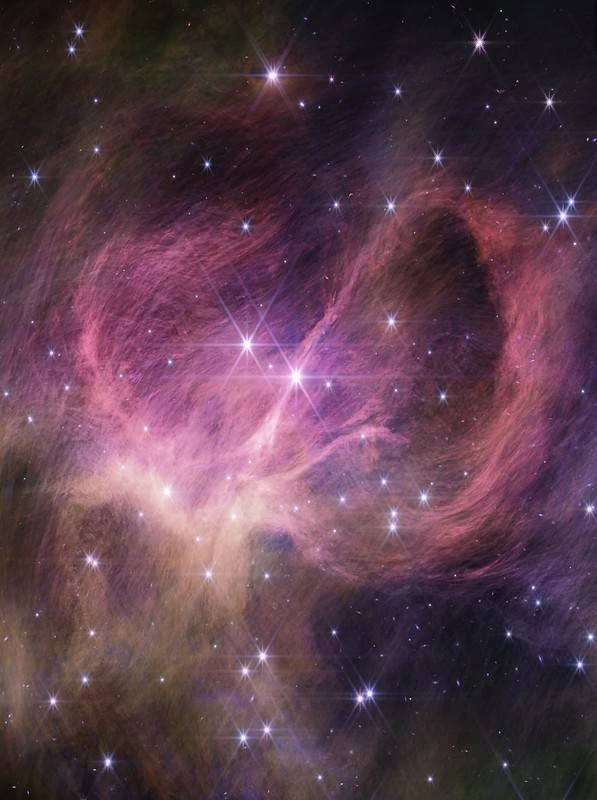
This image: This image from the NIRCam (Near-Infrared Camera) instrument on NASA’s James Webb Space Telescope shows the central portion of the star cluster IC 348. Astronomers combed the cluster in search of tiny, free-floating brown dwarfs: objects too small to be stars but larger than most planets. They found three brown dwarfs that are less than eight times the mass of Jupiter. The smallest weighs just three to four times Jupiter, challenging theories for star formation.
The wispy curtains filling the image are interstellar material reflecting the light from the cluster’s stars – what is known as a reflection nebula. The material also includes carbon-containing molecules known as polycyclic aromatic hydrocarbons, or PAHs. The bright star closest to the center of the frame is actually a pair of type B stars in a binary system, which are the most massive stars in the cluster. Winds from these stars may help sculpt the large loop seen on the right side of the field of view.
Image description: Wispy hair-like filaments of pink-purple fill the middle of the image, curving left and right on either side of the center. On the right, the filaments form a dramatic loop that seems to extend toward the viewer. At lower left are additional yellowsish filaments. Two prominent, bright stars near the center of the image show Webb’s eight-point diffraction spikes. Dozens of fainter stars are scattered across the image.
#nasa #jameswebb #space #telescope #science #tangled
Unique. That’s what you are.
Not quite stars, not quite planets — brown dwarfs are objects that fall in between. Within the star cluster shown in this image, Webb observed the tiniest, free-floating brown dwarf ever discovered.
Webb’s sharp infrared eye found this record-breaking brown dwarf in star cluster IC 348, which is about 1000 light-years away and only 5 million years old.
Studying brown dwarfs helps us understand star formation as well as exoplanets, or planets beyond our solar system. Not only is there overlap between the smallest brown dwarfs and the largest exoplanets, free-floating brown dwarfs come with no stars attached — unlike exoplanets, which can be hidden in the glare of their host stars.
But brown dwarfs aren’t the only free agents in space. Could this discovery be of an uncommon “rogue planet” instead? It’s unlikely: The surrounding stars are both young and low-mass, so they probably could not have produced and then ejected a giant planet in such a short time.
We still don’t quite understand how brown dwarfs this small are even able to form. Webb's got more to do: Future surveys can search for similar objects to clarify their status, as well as the mysteries of their formation and composition. More: www.nasa.gov/missions/webb/nasas-webb-identifies-tiniest-...
Credit: NASA, ESA, CSA, STScI, Kevin Luhman (PSU), Catarina Alves de Oliveira (ESA)
This image: This image from the NIRCam (Near-Infrared Camera) instrument on NASA’s James Webb Space Telescope shows the central portion of the star cluster IC 348. Astronomers combed the cluster in search of tiny, free-floating brown dwarfs: objects too small to be stars but larger than most planets. They found three brown dwarfs that are less than eight times the mass of Jupiter. The smallest weighs just three to four times Jupiter, challenging theories for star formation.
The wispy curtains filling the image are interstellar material reflecting the light from the cluster’s stars – what is known as a reflection nebula. The material also includes carbon-containing molecules known as polycyclic aromatic hydrocarbons, or PAHs. The bright star closest to the center of the frame is actually a pair of type B stars in a binary system, which are the most massive stars in the cluster. Winds from these stars may help sculpt the large loop seen on the right side of the field of view.
Image description: Wispy hair-like filaments of pink-purple fill the middle of the image, curving left and right on either side of the center. On the right, the filaments form a dramatic loop that seems to extend toward the viewer. At lower left are additional yellowsish filaments. Two prominent, bright stars near the center of the image show Webb’s eight-point diffraction spikes. Dozens of fainter stars are scattered across the image.
#nasa #jameswebb #space #telescope #science #tangled


| 27,000 mlx | |
| 25 | |
| 4 |