I ran a small real-world test on American Airlines seat…

0 reactions
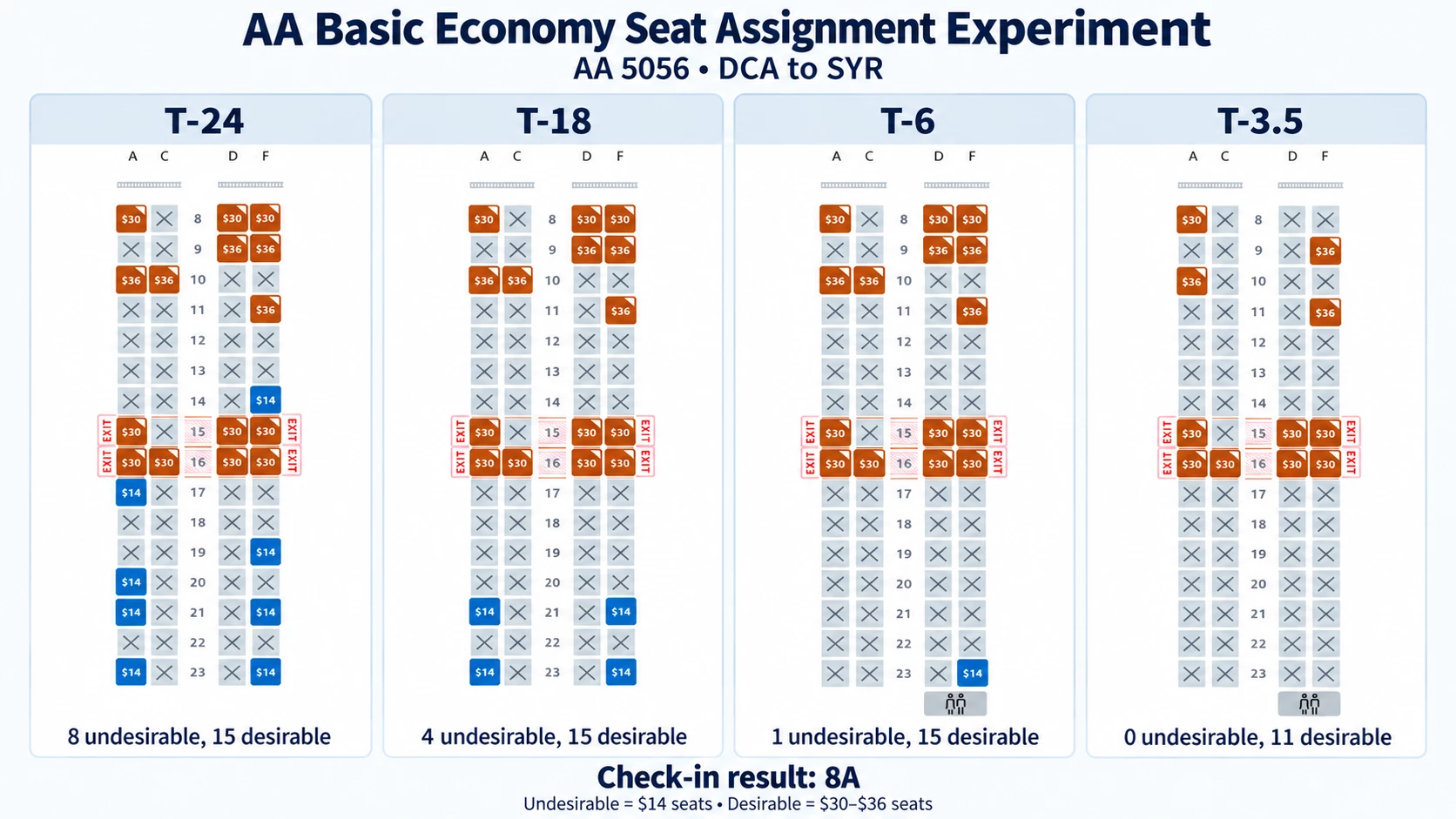
I ran a small real-world test on American Airlines seat assignment progression over a 21 hour period. Checking in ASAP may not always be the best strategy.
I ran a small real-world test on American Airlines (AA 5056, DCA-SYR) seat assignment progression over a 21 hour period. I bought the most basic economy fare; my seat would be assigned at check-in.
My theory was that checking in at **T-24** hours might actually be worse if the system first assigns the cheapest, least desirable seats while holding better seats for sale. Since this aircraft is 2-2 with no middle seats, the downside of waiting was pretty limited.
The seat map evolved like this:
**T-24:** 8 undesirable $14 seats, 15 better $30-$36 seats
**T-18:** 4 undesirable, 15 better
**T-6:** 1 undesirable, 15 better
**T-3.5:** 0 undesirable, 11 better
So the cheaper seats disappeared first, while the more expensive forward and exit-row seats stayed protected much longer.
I checked in at **T-3.5**, right after the last cheap seat disappeared and the better inventory had started being used.
**Result: 8A**, the front-most available $30 seat, assigned for free.
Obviously one flight doesn’t prove AA’s algorithm always works this way, but it was a pretty clean example of why “check in exactly at **T-24**” may not always be the best strategy for Basic Economy, especially on an aircraft with no middle seats.
#education
source
I ran a small real-world test on American Airlines (AA 5056, DCA-SYR) seat assignment progression over a 21 hour period. I bought the most basic economy fare; my seat would be assigned at check-in.
My theory was that checking in at **T-24** hours might actually be worse if the system first assigns the cheapest, least desirable seats while holding better seats for sale. Since this aircraft is 2-2 with no middle seats, the downside of waiting was pretty limited.
The seat map evolved like this:
**T-24:** 8 undesirable $14 seats, 15 better $30-$36 seats
**T-18:** 4 undesirable, 15 better
**T-6:** 1 undesirable, 15 better
**T-3.5:** 0 undesirable, 11 better
So the cheaper seats disappeared first, while the more expensive forward and exit-row seats stayed protected much longer.
I checked in at **T-3.5**, right after the last cheap seat disappeared and the better inventory had started being used.
**Result: 8A**, the front-most available $30 seat, assigned for free.
Obviously one flight doesn’t prove AA’s algorithm always works this way, but it was a pretty clean example of why “check in exactly at **T-24**” may not always be the best strategy for Basic Economy, especially on an aircraft with no middle seats.
#education
source


| 2,000 mlx | |
| 2 | |
| 0 |