How many countries have been led by a woman? Until the…

0 reactions
How many countries have been led by a woman?
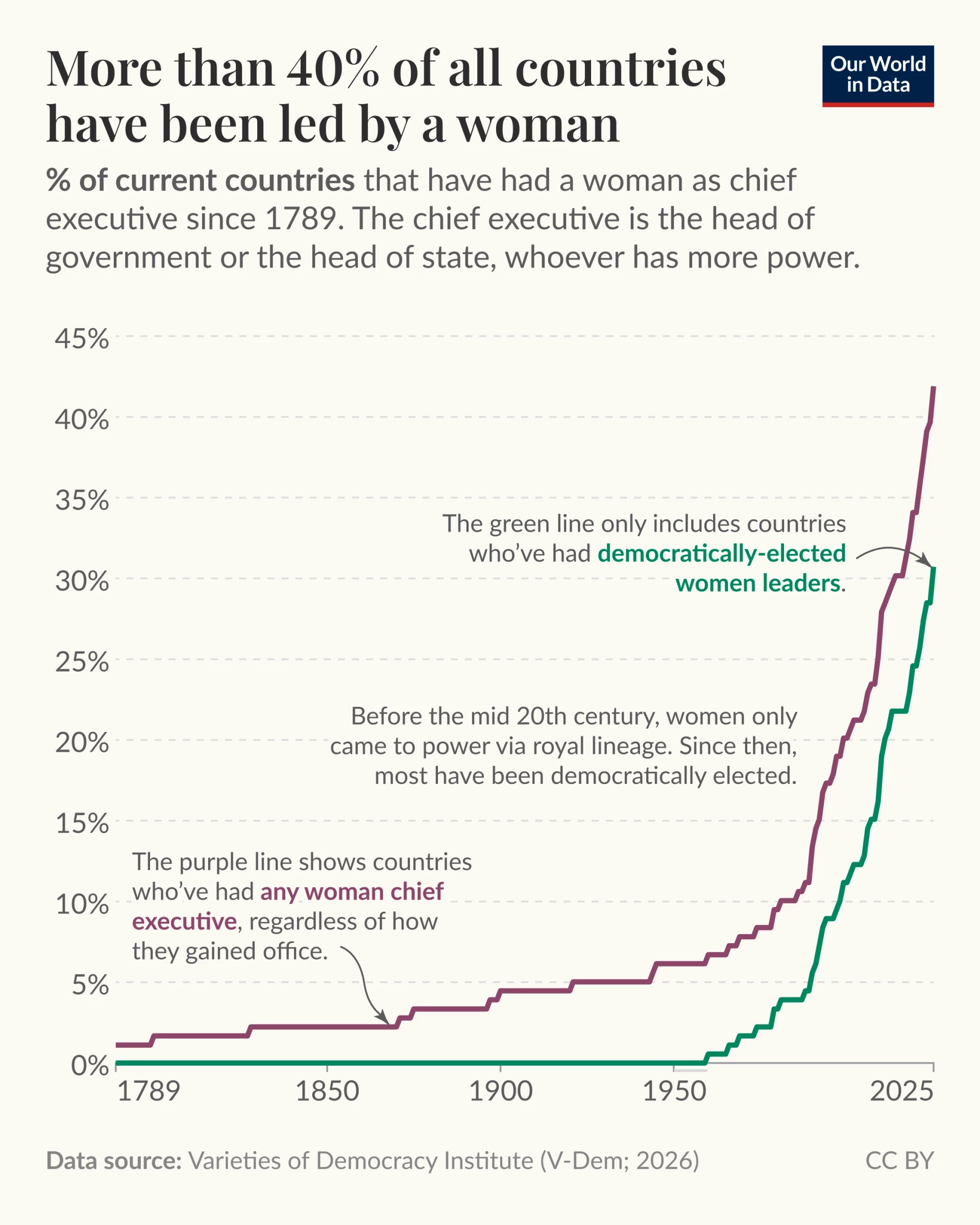
Until the middle of the 20th century, few countries had political leaders that were women. These were monarchs, who rose to their positions because of their royal lineage.
Since then, many more countries have had a woman as chief executive — that is, the head of state or head of government, depending on who has more power. This trend has been driven mostly by democracies.
This began with Sri Lanka’s democratically elected Sirimavo Bandaranaike in 1960. It has also included democratic leaders who were directly elected by their citizens (instead of being elected through elected representatives), with the first being Nicaraguan president Violeta Chamorro in 1990.
The chart shows that this trend has accelerated recently. More than 40% of countries have now had a woman leader (regardless of how they gained office, the purple line), and over 30% have had a democratically elected one (green line).
While there has been progress for women leaders, they remain underrepresented, especially in the highest offices.
**Data source:** Varieties of Democracy Institute (V-Dem; 2026)
**Tools used:** OWID-Grapher and Figma
#education
source
Until the middle of the 20th century, few countries had political leaders that were women. These were monarchs, who rose to their positions because of their royal lineage.
Since then, many more countries have had a woman as chief executive — that is, the head of state or head of government, depending on who has more power. This trend has been driven mostly by democracies.
This began with Sri Lanka’s democratically elected Sirimavo Bandaranaike in 1960. It has also included democratic leaders who were directly elected by their citizens (instead of being elected through elected representatives), with the first being Nicaraguan president Violeta Chamorro in 1990.
The chart shows that this trend has accelerated recently. More than 40% of countries have now had a woman leader (regardless of how they gained office, the purple line), and over 30% have had a democratically elected one (green line).
While there has been progress for women leaders, they remain underrepresented, especially in the highest offices.
**Data source:** Varieties of Democracy Institute (V-Dem; 2026)
**Tools used:** OWID-Grapher and Figma
#education
source


| 1,000 mlx | |
| 2 | |
| 0 |