13 reactions
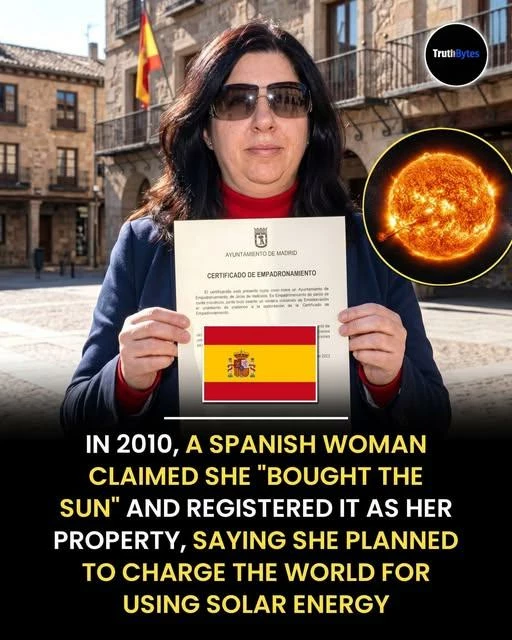
In December 2010, Ángeles Durán from Galicia, Spain, gained global attention after claiming she had registered legal ownership of the Sun through a local notary public.
She based her claim on a perceived loophole in the 1967 Outer Space Treaty; while the treaty prevents nations from claiming sovereignty over celestial bodies, Durán argued it did not explicitly forbid individuals from doing so.
Following her notarization, she announced plans to charge companies and individuals utilizing solar energy, particularly those operating commercial solar panels.
However, she maintained that her motives were largely philanthropic, proposing to donate half of the collected revenues to the Spanish government for public causes like pensions and healthcare, with the remainder split among research funds, ending world hunger, and her own use.
Despite the widespread media coverage, international legal experts quickly clarified that Durán's claim had no actual legal standing. Under international space law, celestial bodies are designated as the "province of all mankind" and are entirely exempt from private or national appropriation.
Furthermore, a notary public simply certifies that a statement was made rather than validating its legal accuracy or granting ownership rights.
Durán later attempted to sell plots of the Sun on eBay in 2015, which led to her listings being removed for violating the platform's intangible goods policy and a subsequent lawsuit that was ultimately dismissed.
Today, her story is remembered as a symbolic and highly unusual legal curiosity that temporarily sparked worldwide discussion on the boundaries of property law.
#wilgman #historical_events
She based her claim on a perceived loophole in the 1967 Outer Space Treaty; while the treaty prevents nations from claiming sovereignty over celestial bodies, Durán argued it did not explicitly forbid individuals from doing so.
Following her notarization, she announced plans to charge companies and individuals utilizing solar energy, particularly those operating commercial solar panels.
However, she maintained that her motives were largely philanthropic, proposing to donate half of the collected revenues to the Spanish government for public causes like pensions and healthcare, with the remainder split among research funds, ending world hunger, and her own use.
Despite the widespread media coverage, international legal experts quickly clarified that Durán's claim had no actual legal standing. Under international space law, celestial bodies are designated as the "province of all mankind" and are entirely exempt from private or national appropriation.
Furthermore, a notary public simply certifies that a statement was made rather than validating its legal accuracy or granting ownership rights.
Durán later attempted to sell plots of the Sun on eBay in 2015, which led to her listings being removed for violating the platform's intangible goods policy and a subsequent lawsuit that was ultimately dismissed.
Today, her story is remembered as a symbolic and highly unusual legal curiosity that temporarily sparked worldwide discussion on the boundaries of property law.
#wilgman #historical_events


3

3

2

1

1

4 reactions
🤣
Whispers from History/22 August
The Wars of the Roses
The Wars of the Roses, a series of dynastic conflicts between the rival houses of Lancaster and York, culminated dramatically at the Battle of Bosworth Field on August 22, 1485. This decisive clash ended three decades of civil war that had torn England apart and reshaped its monarchy.
The battle pitted King Richard III, the last Yorkist ruler, against Henry Tudor, a Lancastrian claimant who had spent much of his life in exile. Despite Richard’s experience and the larger reputation of his forces, shifting allegiances proved crucial. Many noblemen withheld their support or defected to Henry’s side during the fighting, undermining Richard’s chances of victory.
In a final act of courage, Richard charged directly at Henry in an attempt to end the contest swiftly. However, he was overwhelmed and slain on the battlefield, becoming the last English king to die in combat. His death marked the fall of the House of York and the end of Plantagenet rule.
Henry Tudor was crowned as Henry VII, founding the Tudor dynasty. By marrying Elizabeth of York, he united the warring houses, symbolically ending the conflict. His victory ushered in a new era of relative stability and laid the foundation for modern England.
#war_of_the_roses #medieval #tanagled_family #whisper_from_history #historyfacts #history #Historical_events #England
Whispers from History/22 August
The Wars of the Roses
The Wars of the Roses, a series of dynastic conflicts between the rival houses of Lancaster and York, culminated dramatically at the Battle of Bosworth Field on August 22, 1485. This decisive clash ended three decades of civil war that had torn England apart and reshaped its monarchy.
The battle pitted King Richard III, the last Yorkist ruler, against Henry Tudor, a Lancastrian claimant who had spent much of his life in exile. Despite Richard’s experience and the larger reputation of his forces, shifting allegiances proved crucial. Many noblemen withheld their support or defected to Henry’s side during the fighting, undermining Richard’s chances of victory.
In a final act of courage, Richard charged directly at Henry in an attempt to end the contest swiftly. However, he was overwhelmed and slain on the battlefield, becoming the last English king to die in combat. His death marked the fall of the House of York and the end of Plantagenet rule.
Henry Tudor was crowned as Henry VII, founding the Tudor dynasty. By marrying Elizabeth of York, he united the warring houses, symbolically ending the conflict. His victory ushered in a new era of relative stability and laid the foundation for modern England.
#war_of_the_roses #medieval #tanagled_family #whisper_from_history #historyfacts #history #Historical_events #England
4