9
10
302
58
112
515








9 reactions
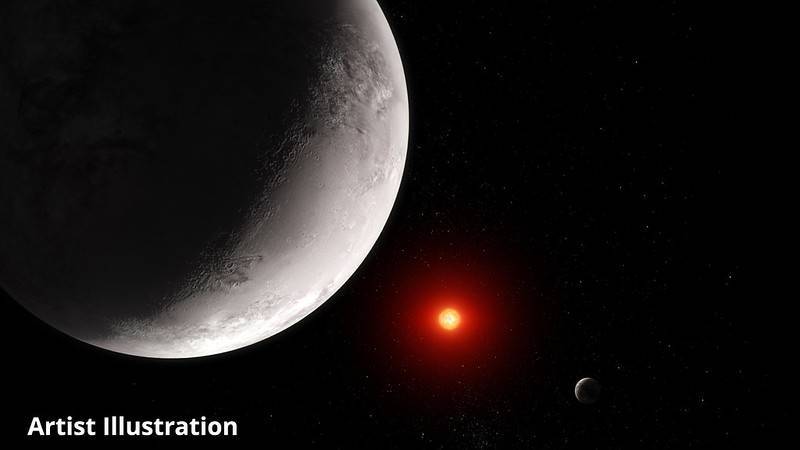
ARTIST ILLUSTRATION: Webb Rules Out Thick Carbon Dioxide Atmosphere for Rocky ExoplanetTRAPPIST-1 b lacked atmosphere.
TRAPPIST-1 c? Much the same.
Though thought to be similar to Venus both in size and amount of radiation from its star, Webb found that TRAPPIST-1 c lacks Venus’s thick carbon dioxide-rich atmosphere. If there is an atmosphere, it’s very thin.
A refresher: TRAPPIST-1 c is the second planet from its star, the M dwarf TRAPPIST-1. M dwarf stars are intriguing because they are 10 times as common and two times more likely to have rocky planets than stars like our Sun. TRAPPIST-1 has seven!
Young M dwarf stars are energetic, emitting X-ray and UV radiation that can strip young planetary atmospheres away. It’s unknown if systems like these had enough water, carbon dioxide, or other ingredients to make atmospheres when the planets formed.
Webb is so sensitive that it can search for elements and molecules like oxygen, nitrogen, and carbon dioxide in exoplanet atmospheres. The mystery remains — can planets orbiting small M dwarfs sustain the atmospheres needed to support life as we know it?
TRAPPIST-1 c? Much the same.
Though thought to be similar to Venus both in size and amount of radiation from its star, Webb found that TRAPPIST-1 c lacks Venus’s thick carbon dioxide-rich atmosphere. If there is an atmosphere, it’s very thin.
A refresher: TRAPPIST-1 c is the second planet from its star, the M dwarf TRAPPIST-1. M dwarf stars are intriguing because they are 10 times as common and two times more likely to have rocky planets than stars like our Sun. TRAPPIST-1 has seven!
Young M dwarf stars are energetic, emitting X-ray and UV radiation that can strip young planetary atmospheres away. It’s unknown if systems like these had enough water, carbon dioxide, or other ingredients to make atmospheres when the planets formed.
Webb is so sensitive that it can search for elements and molecules like oxygen, nitrogen, and carbon dioxide in exoplanet atmospheres. The mystery remains — can planets orbiting small M dwarfs sustain the atmospheres needed to support life as we know it?


8
7 reactions
Webb Makes First Detection of Crucial Carbon Molecule
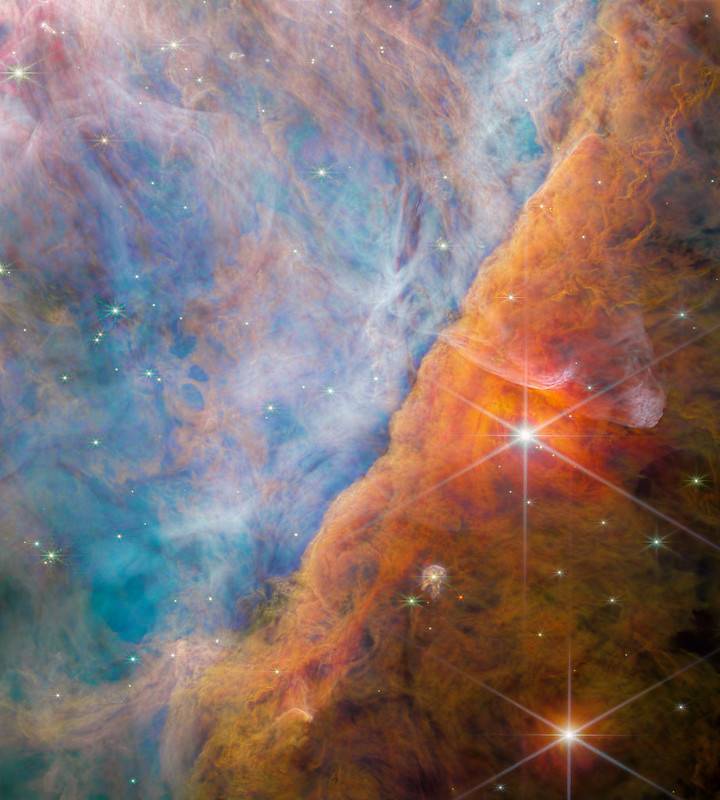
(Orion Bar NIRCam Image)This image taken by Webb’s NIRCam (Near-Infrared Camera) shows a part of the Orion Nebula known as the Orion Bar.
While observing the Orion Bar, Webb made the first detection ever of a crucial carbon molecule called methyl cation (pronounced cat-eye-on) in space. Carbon compounds are the foundation of life as we know it, and methyl cation (CH3+) plays an important role in forming more complex carbon-based molecules.
Within this region, Webb found methyl cation inside a planet-forming disk surrounding a young star system. The disk was bombarded with UV radiation from nearby young stars. While UV radiation is typically expected to destroy complex carbon molecules, the science team believes it may actually be the source of energy necessary for methyl cation — and with it, more complex carbon molecules — to form. Ultimately, understanding how UV radiation changes the chemistry of these disks could tell us more about the origins of life.
Learn more: go.nasa.gov/3Xxpc3q
Credit: ESA/Webb, NASA, CSA, M. Zamani (ESA/Webb), PDRs4ALL ERS Team
Image description: Billowy, multi-hued clouds fill the field of view. The scene is divided by an undulating formation running diagonally from lower left to upper right. On the left side, the clouds are various shades of blue with some translucent orange wisps throughout. On the right side, the clouds vary from bright orange-red to brown as you go from left to right. Here, there are two bright, prominent stars with eight diffraction spikes, as well as a star that appears surrounded by a jellyfish-shaped blob. Additional fainter stars are scattered across the entire image as dots.
#nasa #jameswebb #space #telescope #science
(Orion Bar NIRCam Image)This image taken by Webb’s NIRCam (Near-Infrared Camera) shows a part of the Orion Nebula known as the Orion Bar.
While observing the Orion Bar, Webb made the first detection ever of a crucial carbon molecule called methyl cation (pronounced cat-eye-on) in space. Carbon compounds are the foundation of life as we know it, and methyl cation (CH3+) plays an important role in forming more complex carbon-based molecules.
Within this region, Webb found methyl cation inside a planet-forming disk surrounding a young star system. The disk was bombarded with UV radiation from nearby young stars. While UV radiation is typically expected to destroy complex carbon molecules, the science team believes it may actually be the source of energy necessary for methyl cation — and with it, more complex carbon molecules — to form. Ultimately, understanding how UV radiation changes the chemistry of these disks could tell us more about the origins of life.
Learn more: go.nasa.gov/3Xxpc3q
Credit: ESA/Webb, NASA, CSA, M. Zamani (ESA/Webb), PDRs4ALL ERS Team
Image description: Billowy, multi-hued clouds fill the field of view. The scene is divided by an undulating formation running diagonally from lower left to upper right. On the left side, the clouds are various shades of blue with some translucent orange wisps throughout. On the right side, the clouds vary from bright orange-red to brown as you go from left to right. Here, there are two bright, prominent stars with eight diffraction spikes, as well as a star that appears surrounded by a jellyfish-shaped blob. Additional fainter stars are scattered across the entire image as dots.
#nasa #jameswebb #space #telescope #science
6
6 reactions
Webb Snaps Highly Detailed Infrared Image of Actively Forming StarsBabies are burping chaos machines, and baby stars are no exception.
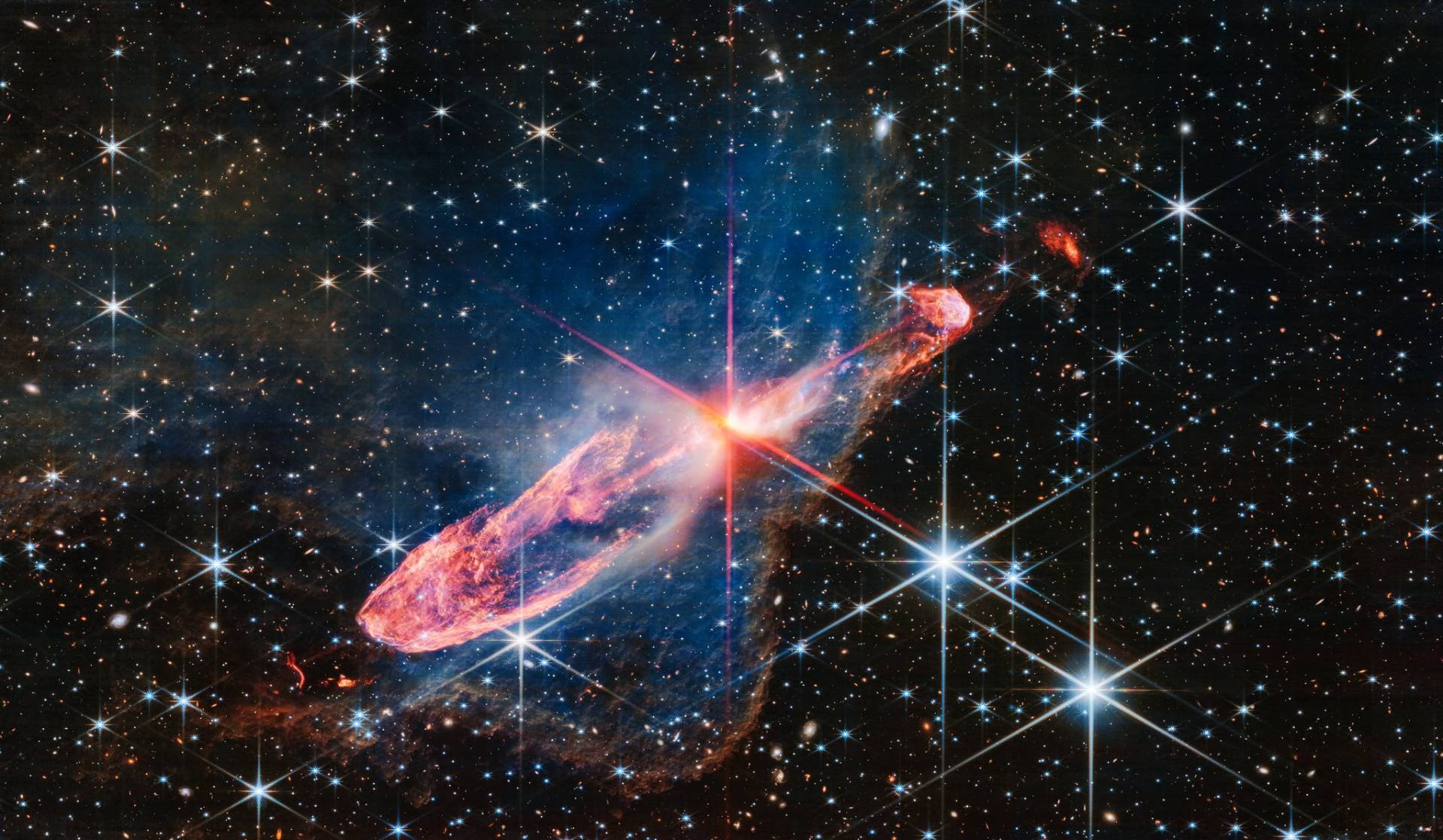
Within the orange-white splotch at the center of this image are 2 actively forming stars. The two stars are buried deep in a disk of gas and dust that feeds their growth. Over thousands of years, the pair repeatedly gobbled up, then spat out the material around them — producing those fiery orange lobes.
The lobes are asymmetrical, with the right one actually angled more towards Earth than the left. The shape of the lobes is influenced by interactions with a surrounding nebula, seen as a blue haze, as well as more recent ejections from the stars. (Though the nebula appears black and opaque in visible light, it’s nearly transparent through Webb’s infrared eyes!)
The stars’ ejections will ultimately determine how much mass they will retain. It’ll take millions of years for these baby stars to grow up and leave the nest, but eventually this area will clear, revealing the fully-fledged stars within. More: go.nasa.gov/472L3Ux
Credit: NASA, ESA, CSA. Image Processing: Joseph DePasquale (STScI)
Image description: At the center of the image is a horizontal orange cloud known as Herbig-Haro 46/47 that is uneven with rounded ends, and tilted from bottom left to top right. In the middle of this cloud is a yellow-white blob with 8 reddish pink diffraction spikes piercing through it. The left lobe of the cloud is thicker. Just off the edge is a tiny red arc that curves in the opposite direction. The right lobe is thinner, and ends in a smaller orange semi-circle that has a faint purple outline. Just off the edge of this lobe is a slightly smaller orange sponge-like blob. A delicate, semi-transparent blue cloud known as a nebula drifts toward the top of the image and peters out toward the left of the frame. Toward the right and bottom, the nebula ends in a soft ridge set off in a translucent orange. The background is filled with stars and galaxies. Two foreground stars with blue diffraction spikes, seen in the bottom right corner, are especially prominent.
#nasa #jameswebb #space #telescope #science
Within the orange-white splotch at the center of this image are 2 actively forming stars. The two stars are buried deep in a disk of gas and dust that feeds their growth. Over thousands of years, the pair repeatedly gobbled up, then spat out the material around them — producing those fiery orange lobes.
The lobes are asymmetrical, with the right one actually angled more towards Earth than the left. The shape of the lobes is influenced by interactions with a surrounding nebula, seen as a blue haze, as well as more recent ejections from the stars. (Though the nebula appears black and opaque in visible light, it’s nearly transparent through Webb’s infrared eyes!)
The stars’ ejections will ultimately determine how much mass they will retain. It’ll take millions of years for these baby stars to grow up and leave the nest, but eventually this area will clear, revealing the fully-fledged stars within. More: go.nasa.gov/472L3Ux
Credit: NASA, ESA, CSA. Image Processing: Joseph DePasquale (STScI)
Image description: At the center of the image is a horizontal orange cloud known as Herbig-Haro 46/47 that is uneven with rounded ends, and tilted from bottom left to top right. In the middle of this cloud is a yellow-white blob with 8 reddish pink diffraction spikes piercing through it. The left lobe of the cloud is thicker. Just off the edge is a tiny red arc that curves in the opposite direction. The right lobe is thinner, and ends in a smaller orange semi-circle that has a faint purple outline. Just off the edge of this lobe is a slightly smaller orange sponge-like blob. A delicate, semi-transparent blue cloud known as a nebula drifts toward the top of the image and peters out toward the left of the frame. Toward the right and bottom, the nebula ends in a soft ridge set off in a translucent orange. The background is filled with stars and galaxies. Two foreground stars with blue diffraction spikes, seen in the bottom right corner, are especially prominent.
#nasa #jameswebb #space #telescope #science
5