
44 reactions
The Marriage Bridge, also known as the “Walking Marriage Bridge,” is a symbolic place for the Mosuo tribe at Lugu Lake. It represents their unique “walking marriage” tradition, where love and relationships are based on mutual affection without formal marriage ties. As couples walk hand in hand across the bridge, it reflects trust, respect, and freedom in love. Surrounded by calm waters and misty mountains, the bridge holds countless stories of romance whispered through generations. Standing there, one can feel both the serenity of nature and the deep cultural spirit of the Mosuo people — love, simple yet profound.
#MarriageBridge #MosuoTribe #LuguLake #WalkingMarriage #CulturalHeritage
#MarriageBridge #MosuoTribe #LuguLake #WalkingMarriage #CulturalHeritage


12

7

7

3 reactions
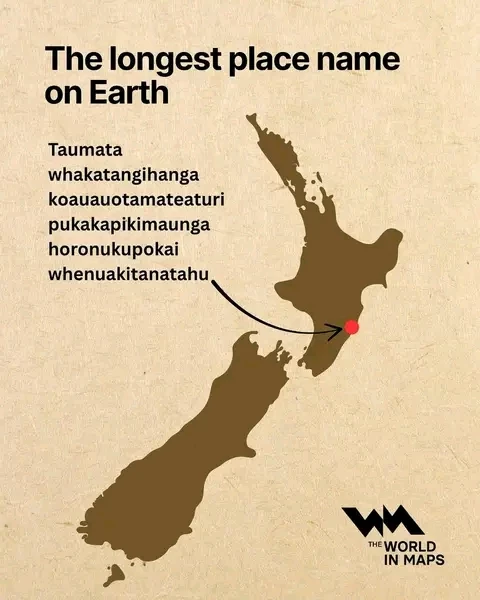
The longest place name on Earth
The longest place name on Earth is:
Taumatawhakatangihangakoauauotamateaturipukakapikimaungahoronukupokaiwhenuakitanatahu
This 85-character Māori name refers to a hill in Hawke's Bay, New Zealand.
Translation:
It roughly means:
"The place where Tamatea, the man with the big knees, who slid, climbed and swallowed mountains, known as the land-eater, played his nose flute to his loved one."
Fun Facts:
It's recognised by the Guinness World Records as the longest place name still in use.
Locals often shorten it to Taumata Hill.
The full name reflects Māori oral tradition, which often includes entire stories in names.
The Hill Where Tamatea Played His Nose Flute
Long ago, in the rolling lands of Hawke's Bay, where the mists rise like whispers from the earth, there lived a great traveler and warrior named TAMATEA-PŌKAI-WHENUA—TAMATEA, the land explorer. But his name was long for a reason, for he was no ordinary man.
They say TAMATEA had PUKAKAPI—great knees like the trunks of trees, strong from years of climbing, sliding, and journeying across the mountains. He would MAUNGA-HORONUKU, swallow mountains, cross vast lands, and leave footprints etched in stone. Wherever he stepped, the earth remembered him.
On one fateful journey, tragedy struck. A fierce battle took the life of his beloved younger brother. In mourning, TAMATEA ascended a sacred TAUMATA, a high hill that touched the sky.
There, he took out his KOAUAU, his sacred nose flute, and played. The song carried sorrow as deep as the ocean and as vast as the land. Each note was a lament for the one he lost and a tribute to the bond they shared.
The hill, the wind, the land—all listened. That place was no longer just a hill. It became a story, a name, a living memory.
And so the people called it:
TAUMATAWHAKATANGIHANGAKOAUAUOTAMATEATURIPUKAKAPIKIMAUNGAHORONUKUPOKAIWHENUAKITANATAHU
—
"The place where TAMATEA, the man with the big knees who slid, climbed, and swallowed mountains, the land-eater, played his nose flute to his beloved TAHU."
#LongestPlaceName #Taumatawhakatangihanga #NewZealand #MāoriCulture #FunFacts #GeographyNerd #TravelTrivia #PlaceNames #LinguisticCuriosity #WorldRecords
#TravelFacts #HiddenGems #OffTheBeatenPath #CulturalHeritage #ExploreNewZealand #LanguageLovers #MāoriHeritage #GeographicTrivia
The longest place name on Earth is:
Taumatawhakatangihangakoauauotamateaturipukakapikimaungahoronukupokaiwhenuakitanatahu
This 85-character Māori name refers to a hill in Hawke's Bay, New Zealand.
Translation:
It roughly means:
"The place where Tamatea, the man with the big knees, who slid, climbed and swallowed mountains, known as the land-eater, played his nose flute to his loved one."
Fun Facts:
It's recognised by the Guinness World Records as the longest place name still in use.
Locals often shorten it to Taumata Hill.
The full name reflects Māori oral tradition, which often includes entire stories in names.
The Hill Where Tamatea Played His Nose Flute
Long ago, in the rolling lands of Hawke's Bay, where the mists rise like whispers from the earth, there lived a great traveler and warrior named TAMATEA-PŌKAI-WHENUA—TAMATEA, the land explorer. But his name was long for a reason, for he was no ordinary man.
They say TAMATEA had PUKAKAPI—great knees like the trunks of trees, strong from years of climbing, sliding, and journeying across the mountains. He would MAUNGA-HORONUKU, swallow mountains, cross vast lands, and leave footprints etched in stone. Wherever he stepped, the earth remembered him.
On one fateful journey, tragedy struck. A fierce battle took the life of his beloved younger brother. In mourning, TAMATEA ascended a sacred TAUMATA, a high hill that touched the sky.
There, he took out his KOAUAU, his sacred nose flute, and played. The song carried sorrow as deep as the ocean and as vast as the land. Each note was a lament for the one he lost and a tribute to the bond they shared.
The hill, the wind, the land—all listened. That place was no longer just a hill. It became a story, a name, a living memory.
And so the people called it:
TAUMATAWHAKATANGIHANGAKOAUAUOTAMATEATURIPUKAKAPIKIMAUNGAHORONUKUPOKAIWHENUAKITANATAHU
—
"The place where TAMATEA, the man with the big knees who slid, climbed, and swallowed mountains, the land-eater, played his nose flute to his beloved TAHU."
#LongestPlaceName #Taumatawhakatangihanga #NewZealand #MāoriCulture #FunFacts #GeographyNerd #TravelTrivia #PlaceNames #LinguisticCuriosity #WorldRecords
#TravelFacts #HiddenGems #OffTheBeatenPath #CulturalHeritage #ExploreNewZealand #LanguageLovers #MāoriHeritage #GeographicTrivia
1
1

1

8 reactions
"Has the final resting place of Genghis Khan been uncovered? A newly discovered 13th-century tomb in Mongolia’s Khentii province sparks intrigue and debate among historians and archaeologists!"
For nearly 800 years, the burial site of Genghis Khan has remained one of history’s greatest mysteries. According to legend, those who buried him were executed to keep its location secret, and Mongols refrained from marking the site to prevent desecration.
Recent excavations near the Onon River in Mongolia’s Khentii province have unearthed what may be the long-lost tomb of the great conqueror. Construction workers accidentally stumbled upon a mass grave atop an ancient stone structure, leading to an extraordinary archaeological investigation.
Forensic analysis revealed a tall male skeleton buried alongside 16 female remains—believed to be wives or concubines—as well as twelve sacrificed horses, a practice historically linked to Mongol elite burials. A treasure trove of gold and silver artifacts was also discovered, further reinforcing the theory that this was the tomb of a powerful warlord.
Researchers from the University of Beijing suggest that the individuals buried alongside the central figure were workers tasked with constructing the tomb, their fate sealed to preserve its secrecy. Moreover, the tomb shows evidence of having been submerged for centuries before the Onon River changed course in the 18th century, explaining why it remained hidden for so long.
While no inscriptions explicitly identify the remains as Genghis Khan’s, the age and stature of the male skeleton—estimated to be between 60 and 75 years old—align with historical records of his passing in 1227. If confirmed, this discovery could rewrite history, finally solving one of the most enduring archaeological enigmas of all time.
#AncientArchitecture #AncientCivilizations #HistoricalSites #AncientRuins #AncientHistory #Archaeology #HistoryLovers #HistoricalLandmarks #CulturalHeritage #AncientWonders #AncientWorld #TimeCapsule #AncientArt #LostCities #HistoryInTheMaking #PastAndPresent #RomanEmpire #RomanHistory #RomanArchitecture #AncientGreece #GreekArchitecture #GreekRuins #Parthenon #AthensHistory #GreekCivilization #archaeology #ancientegypt #ancient #history #usa #uk #egypt
For nearly 800 years, the burial site of Genghis Khan has remained one of history’s greatest mysteries. According to legend, those who buried him were executed to keep its location secret, and Mongols refrained from marking the site to prevent desecration.
Recent excavations near the Onon River in Mongolia’s Khentii province have unearthed what may be the long-lost tomb of the great conqueror. Construction workers accidentally stumbled upon a mass grave atop an ancient stone structure, leading to an extraordinary archaeological investigation.
Forensic analysis revealed a tall male skeleton buried alongside 16 female remains—believed to be wives or concubines—as well as twelve sacrificed horses, a practice historically linked to Mongol elite burials. A treasure trove of gold and silver artifacts was also discovered, further reinforcing the theory that this was the tomb of a powerful warlord.
Researchers from the University of Beijing suggest that the individuals buried alongside the central figure were workers tasked with constructing the tomb, their fate sealed to preserve its secrecy. Moreover, the tomb shows evidence of having been submerged for centuries before the Onon River changed course in the 18th century, explaining why it remained hidden for so long.
While no inscriptions explicitly identify the remains as Genghis Khan’s, the age and stature of the male skeleton—estimated to be between 60 and 75 years old—align with historical records of his passing in 1227. If confirmed, this discovery could rewrite history, finally solving one of the most enduring archaeological enigmas of all time.
#AncientArchitecture #AncientCivilizations #HistoricalSites #AncientRuins #AncientHistory #Archaeology #HistoryLovers #HistoricalLandmarks #CulturalHeritage #AncientWonders #AncientWorld #TimeCapsule #AncientArt #LostCities #HistoryInTheMaking #PastAndPresent #RomanEmpire #RomanHistory #RomanArchitecture #AncientGreece #GreekArchitecture #GreekRuins #Parthenon #AthensHistory #GreekCivilization #archaeology #ancientegypt #ancient #history #usa #uk #egypt
4
2
2